


























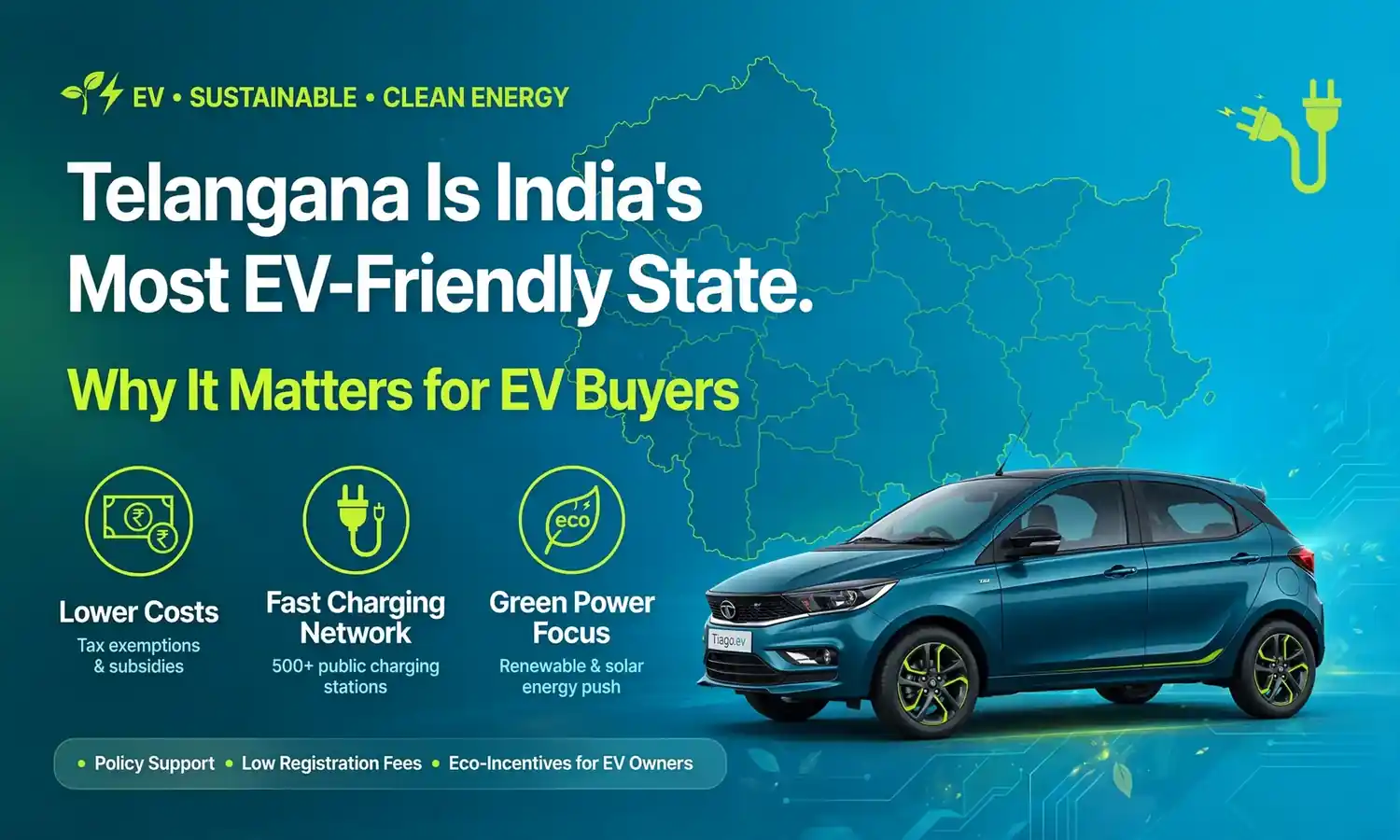
Telangana Is India’s Most EV-Friendly State. Why It Matters for EV Buyers
By Eram Warsi • Published on 20 Sept 2026For years, buying a petrol or diesel car came with one simple assumption: there will be a fuel station somewhere nearby. That confidence took decades ...
For years, buying a petrol or diesel car came with one simple assumption: there will be a fuel station somewhere nearby. That confidence took decades to build. Electric cars do not have that luxury yet. But EV adoption in India is growing quickly, and the next battle is no longer only about how many electric cars are sold. It is about how easy they are to live with after you buy one.
That is why Telangana topping the HERE-SBD EV Index 2026 matters. The state jumped from 25th in 2025 to 1st in 2026, while Delhi fell from 4th to 17th. The index looks beyond the raw number of chargers and considers charger availability, charging power, EV penetration and the relationship between EVs and charging infrastructure.
EV adoption is growing, and the infrastructure has to catch up
India sold more than 25.5 lakh EVs across vehicle categories in FY2025-26, up about 25% year on year, according to Vahan-based data. Electric passenger vehicle sales grew much faster, reaching nearly 2 lakh units, an 83.6% YoY increase over FY2024-25.
The trend is even clearer in individual months. In June 2026, India's overall EV retail sales reached 3.06 lakh units, up nearly 63% YoY. Electric passenger vehicles crossed 31,800 units that month.
There is another factor making people rethink their next car. The rollout of E20 petrol has created questions around fuel economy and compatibility, particularly for older vehicles. FADA said petrol's share of passenger vehicle sales fell to around 41% in July 2026, while EVs reached nearly 8%, although consumer concerns around E20 have also been linked to misinformation and uncertainty.
That does not mean petrol cars are suddenly going away. They have an enormous advantage: 100-plus years of infrastructure, habits and supply chains behind them.
An EV is trying to build its equivalent system in real time.
What does "EV infrastructure" actually mean?
When people hear EV infrastructure, they usually think of charging stations.
That is only one part of it.
A usable EV ecosystem needs:
Home charging, especially for apartment and independent-house owners
Public AC chargers for longer parking periods
DC fast chargers for highways and quick top-ups
Chargers at offices, malls and hotels
Highway charging corridors
Reliable electricity supply
Adequate grid capacity
Easy digital payments
Accurate charger locations
Real-time availability information
Working chargers, not dead boxes sitting beside a parking space
Service and repair support
Battery recycling and replacement infrastructure
This last point is important.
100 chargers on Google Maps do not necessarily mean 100 usable chargers.
The 2026 HERE-SBD index found that charging reliability remains a major issue. Around 46% of consumers identified limited charging infrastructure as a major barrier, while 30% cited charging cost concerns. Among existing EV owners surveyed, 83% said they had avoided trips because of charging concerns and 77% had encountered faulty charging stations.
So the real question is not:
It is:
Why Telangana jumped to No. 1
Telangana's rise is interesting because it shows what happens when a state starts treating EV charging as an infrastructure problem rather than simply a car-sales problem.
The state's Clean and Green Energy Policy 2025 targets an additional 6,000 public charging stations, including battery-swapping facilities, by 2030, and 12,000 by 2035. The policy also provides for charging infrastructure through public-private partnerships and has removed fixed charges for the LT-EV electricity category.
The state is also working on a real-time EV charging dashboard to map charging stations and identify infrastructure gaps. It has been working on a policy to require EV charging points in apartment basements too.
That last part could be more important than another flashy highway charger.
Because for a normal EV owner, home charging is the petrol pump.
If you return home every evening, plug in your car and wake up with 80% charge, you may rarely need a public charger.
Charging an EV can be much cheaper than filling a petrol car
Let's take a simple example.
Suppose an EV consumes around 15 kWh per 100 km.
If home electricity costs ₹9 per kWh:
Charging cost = ₹135 per 100 km
Now consider a petrol car returning 15 kmpl.
At ₹100 per litre:
Fuel cost = about ₹667 per 100 km
That is a huge difference.
For someone driving 1,000 km every month:
|
Running |
EV at ₹9/kWh |
Petrol at 15 kmpl |
|---|---|---|
|
100 km |
₹135 |
₹667 |
|
500 km |
₹675 |
₹3,333 |
|
1,000 km |
₹1,350 |
₹6,667 |
|
12,000 km/year |
₹16,200 |
₹80,000 |
The actual numbers will vary with the vehicle, electricity tariff, charging losses, petrol price and driving conditions.
But the basic EV advantage remains: electricity can cost much less per kilometre than petrol when you charge mostly at home.
Public charging can be more expensive, particularly on fast chargers. That is why a state with thousands of public chargers but poor home-charging access may still be difficult for some owners.
Why charger reliability matters more than charger count
Imagine two states.
State A has 10,000 chargers, but many are unreliable, poorly located or frequently occupied.
State B has 6,000 chargers, but they are well distributed, powerful, working and easy to find.
For an EV owner, State B could offer a better experience.
This is exactly why the HERE-SBD index uses multiple measures rather than simply counting chargers. It considers chargers relative to road length, average charger power, EV share and the ratio of EVs to charging infrastructure.
India has also been adding charging capacity quickly. The 2026 index says more than 31,500 public charge points were added during the latest measurement period, while total charging capacity increased by 1.65 GW. Average charger power increased from 32 kW to 45 kW.
That is important because a 7 kW charger and a 150 kW charger are not the same thing.
One is useful when your car is parked for hours.
The other can make a highway stop far shorter.
Telangana's ranking does not mean every EV buyer should move there
There is an important catch.
EV readiness and EV adoption are not the same thing.
Reports from Telangana have pointed out that the state's charging network is strong even though EV adoption has not always kept pace. High upfront vehicle prices, battery concerns, awareness and resale value remain issues.
So the ranking is better understood as a measure of how prepared the ecosystem is, rather than a statement that every Telangana resident already has a perfect EV experience.
There is also another interesting contrast.
The HERE-SBD EV Index 2026 puts Telangana first and Delhi 17th, while the NITI Aayog India Electric Mobility Index 2025 ranks Delhi first overall, followed by Maharashtra and Karnataka. The two indices measure different things, so their rankings should not be treated as contradictory scorecards. NITI Aayog's index looks at transport electrification, charging readiness, and EV research and innovation.
What this means for an ordinary EV buyer
If you are thinking about buying an electric car, state-level EV infrastructure should be part of your calculation.
Before buying, check five things:
1. Can you charge at home?
This is the biggest question.
If you have a dedicated parking spot with access to electricity, an EV becomes much easier to live with.
2. What does your electricity connection support?
A home charger may require electrical upgrades depending on the charger's power requirement and your existing connection.
3. Where are your regular public chargers?
Check chargers near your:
Home
Office
Highway routes
Parents' or relatives' homes
Frequent weekend destinations
4. What does charging actually cost?
Do not assume public charging will cost the same as home charging.
Your EV's running cost can look fantastic on a ₹9/kWh home tariff and considerably less attractive if you depend heavily on expensive fast chargers.
5. How reliable is the network?
Look beyond the number displayed on a map.
Check whether chargers are operational, whether they support your car's connector, their charging speed and whether users regularly report failures.
The real EV race has started
India spent more than a century building the petrol and diesel ecosystem we now take for granted. Roads, fuel stations, workshops, mechanics, logistics, refineries and consumer habits all grew around the internal-combustion engine.
EVs are trying to build a similar ecosystem in a much shorter period.
That makes Telangana's rise important.
The story is no longer simply "How many EVs did India sell?"
The bigger question is:
"Can the infrastructure grow fast enough to make owning one feel normal?"
/Xuv 3xo RevX-1.webp)
 1.webp)