




























Kia Carens Clavis EV Gets 15-Year Unlimited-Km Battery Warranty: How Much Can You Save?
By Gaurav Cyril • Published on 17 Sept 2026The Kia Carens Clavis EV just got something that could make long-term EV ownership a lot less stressful: a 15-year, unlimited-kilometre warranty on it...
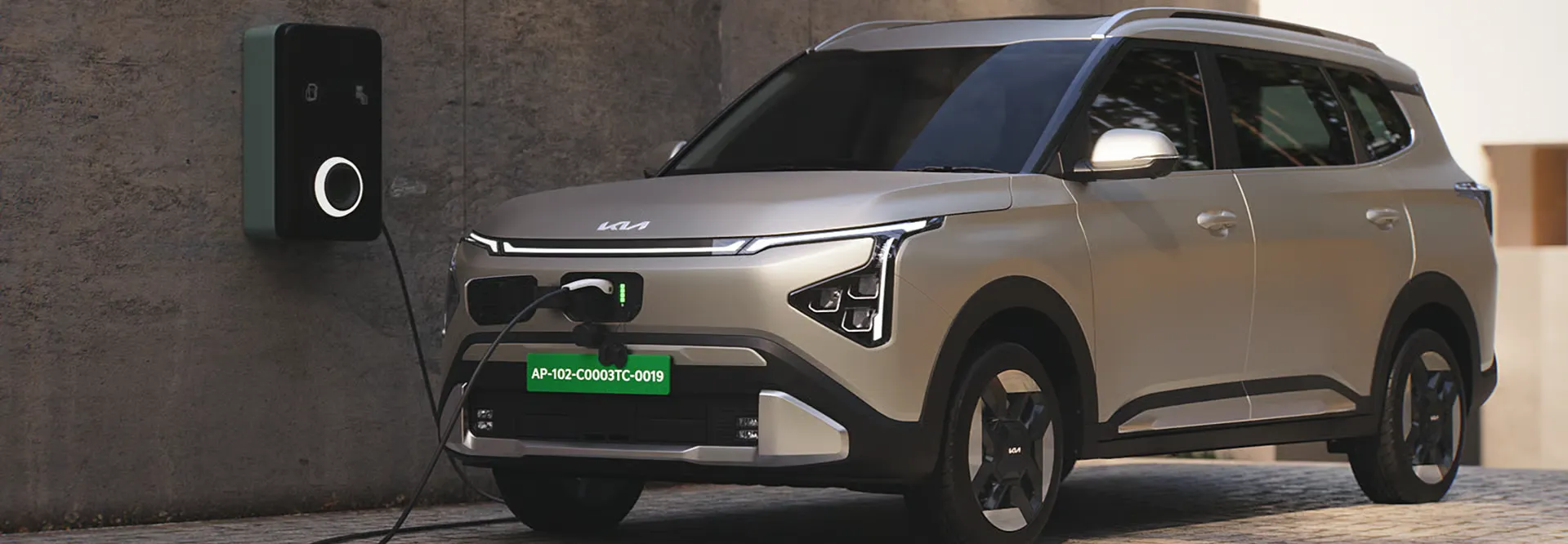
The Kia Carens Clavis EV just got something that could make long-term EV ownership a lot less stressful: a 15-year, unlimited-kilometre warranty on its high-voltage battery for the first owner.
But there is another number that matters more to most buyers: how much money does the EV save every month compared with a petrol Clavis?
At a running distance of 500 km per month, the answer can be around ₹2,700 to ₹4,000 per month, depending on which petrol version and electricity tariff you compare it with.
For a simple calculation, this article uses the 1.5-litre petrol Clavis, which has an ARAI claimed efficiency of 15.34 kmpl.
For the EV, we use the battery and claimed range figures from Kia and an assumed home-charging electricity rate of ₹9 per unit. Kia lists the Clavis EV with 42 kWh and 51.4 kWh battery options, with claimed ranges of 404 km and 490 km respectively.
Kia Carens Clavis EV 15-Year Battery Warranty Explained
Kia has introduced a lifetime high-voltage battery capacity warranty for the first owner, with Kia defining lifetime as 15 years from the date of vehicle delivery.
The warranty has no kilometre limit.
However, there is an important condition. The coverage applies when the battery's capacity falls below 70% of its original capacity. The updated warranty applies to Carens Clavis EVs retailed from August 1, 2026.
This is different from saying that every battery-related issue is covered for 15 years.
The standard vehicle warranty remains 3 years with unlimited kilometres, while the special 15-year coverage is specifically for high-voltage battery capacity.
Who gets the 15-year unlimited-km warranty?
|
Buyer |
High-voltage battery capacity warranty |
|---|---|
|
First owner |
15 years / unlimited km |
|
Second owner |
8 years / 1,60,000 km |
|
Commercial/taxi use |
8 years / 1,60,000 km |
|
Battery capacity threshold |
Below 70% of original capacity |
So, if you plan to keep the Clavis EV for 10 to 15 years, the new warranty becomes particularly relevant.
How Much Does Carens Clavis EV Save Every Month?
Let's take a relatively modest usage of 500 km per month.
For the petrol Clavis, the 1.5-litre naturally aspirated petrol engine has an ARAI efficiency of 15.34 kmpl.
For this calculation:
Monthly driving: 500 km
Petrol price assumed: ₹102/litre
Petrol efficiency: 15.34 kmpl
Home electricity: ₹9/kWh
EV energy consumption based on Kia's battery and claimed range figures
Charging losses are not separately added, so actual EV cost can be slightly higher
Monthly running cost
|
Cost factor |
Carens Clavis Petrol |
Carens Clavis EV |
|---|---|---|
|
Monthly distance |
500 km |
500 km |
|
Efficiency |
15.34 kmpl |
~9.57 km/kWh |
|
Energy/fuel required |
~32.6 litres |
~52.3 kWh |
|
Assumed fuel/electricity price |
₹102/litre |
₹9/kWh |
|
Monthly running cost |
₹3,323 |
₹471 |
|
Monthly saving with EV |
₹2,852 |
So, at just 500 km per month, the Clavis EV could save roughly ₹2,850 every month on energy costs under these assumptions.
That works out to approximately ₹34,200 per year.
The saving becomes much larger when the car is driven more.
Kia Carens Clavis EV vs Petrol: Annual Running Cost
At 500 km per month, the car covers 6,000 km every year.
|
Running cost |
Petrol Clavis |
Clavis EV |
|---|---|---|
|
Annual distance |
6,000 km |
6,000 km |
|
Fuel/energy required |
~391 litres petrol |
~628 kWh |
|
Annual fuel/electricity cost |
₹39,870 |
₹5,652 |
|
Annual saving |
₹34,218 | |
|
5-year energy cost |
₹1,99,350 |
₹28,260 |
|
5-year saving |
₹1,71,090 | |
|
10-year energy cost |
₹3,98,700 |
₹56,520 |
|
10-year saving |
₹3,42,180 | |
|
15-year energy cost |
₹5,98,050 |
₹84,780 |
|
15-year saving |
₹5,13,270 |
Important: These are energy-cost calculations, not total ownership costs. Insurance, tyres, servicing, financing, depreciation and charging equipment can change the final ownership cost.
Also, real-world EV efficiency varies with speed, AC use, temperature, traffic and charging losses.
The 15-Year Warranty Changes the EV Ownership Calculation
The interesting part is not simply the ₹34,000 annual fuel saving.
It is what happens when you combine the saving with long-term battery assurance.
Suppose someone drives only 500 km every month.
Over 15 years:
500 × 12 × 15 = 90,000 km
That means the owner could potentially drive the car for 15 years and still remain within the new battery warranty period, without worrying about a kilometre ceiling on that specific capacity warranty.
Kia's warranty, however, is subject to its stated conditions and applies to the first owner.
Financial Aspect: Is the Carens Clavis EV More Expensive to Own?
This is where things become more interesting.
The EV has a considerably higher upfront price than the petrol Clavis.
Kia's current official variant page lists the Carens Clavis EV from ₹18.03 lakh ex-showroom, while the petrol Clavis range starts considerably lower.
So the EV's lower running cost does not automatically mean it is cheaper from day one.
Energy savings vs upfront premium
|
Financial factor |
Approximate figure |
|---|---|
|
EV annual running |
₹5,652 |
|
Petrol annual running |
₹39,870 |
|
Annual energy saving |
₹34,218 |
|
5-year energy saving |
₹1.71 lakh |
|
10-year energy saving |
₹3.42 lakh |
|
15-year energy saving |
₹5.13 lakh |
At only 500 km per month, the running-cost advantage builds slowly because the annual driving distance is only 6,000 km.
This is an important point for low-mileage buyers.
If you drive only 500 km every month, buying the EV purely to save on fuel may not make financial sense immediately because the upfront EV premium is large.
The calculation becomes more attractive for people who drive substantially more kilometres.
The Big Catch: 500 km Per Month Is Very Low Usage
There is a small elephant sitting in this spreadsheet.
500 km a month is only 6,000 km a year.
For this kind of usage, fuel savings alone may not justify paying a large EV premium.
The financial case becomes stronger when:
You drive 1,000 to 2,000+ km every month
You can charge mainly at home
Petrol prices increase over time
You keep the car for many years
You value the long battery warranty
You want to reduce routine petrol expenditure
You plan to use the car for intercity travel and daily commuting
The 15-year battery warranty adds another layer of reassurance because Kia is putting a defined long-term capacity guarantee behind the high-voltage battery for the first owner.
What Exactly Does Kia's 15-Year Battery Warranty Cover?
The important word here is capacity.
Kia states that the first owner's high-voltage battery capacity warranty applies when capacity falls below 70% of the original battery capacity. The coverage is for 15 years from delivery and has no kilometre limit.
It should therefore not be interpreted as:
Normal maintenance and wear-and-tear items remain outside the relevant warranty coverage, and Kia lists exclusions in its warranty terms.
Kia Carens Clavis EV 15-Year Warranty: In a nutshell
The 15-year unlimited-kilometre battery warranty is a major change in the long-term ownership story of the Carens Clavis EV.
At 500 km per month, the estimated energy saving is around ₹2,850 per month, or roughly ₹34,000 per year, using the assumptions in this calculation.
Over 15 years, that could add up to around ₹5.13 lakh in energy savings compared with the 1.5-litre petrol Clavis, before considering changes in petrol and electricity prices.
But there is a catch.
At only 500 km per month, the EV's running-cost advantage builds slowly. The stronger financial case appears as monthly usage increases, especially beyond 1,000 km.
The new battery warranty makes the EV easier to consider as a long-term 10 to 15-year family car, particularly for a first owner who plans to keep it for a long time.
And that may be the real story here. Kia is not simply selling an electric MPV with a battery. It is trying to remove one of the biggest long-term questions buyers have about EVs: "What happens to the battery after several years?"
For the first owner, Kia's answer is now: 15 years, unlimited kilometres, subject to the warranty conditions and the 70% capacity threshold.