















Why Does the 2026 Mahindra Thar OG Have No Soft Top?
By Gaurav Cyril • Published on 3 Oct 2026The Thar was born with a roof you could take off. In 2026, Mahindra has decided that the roof should stay exactly where it is. The new Mahindra Thar ...
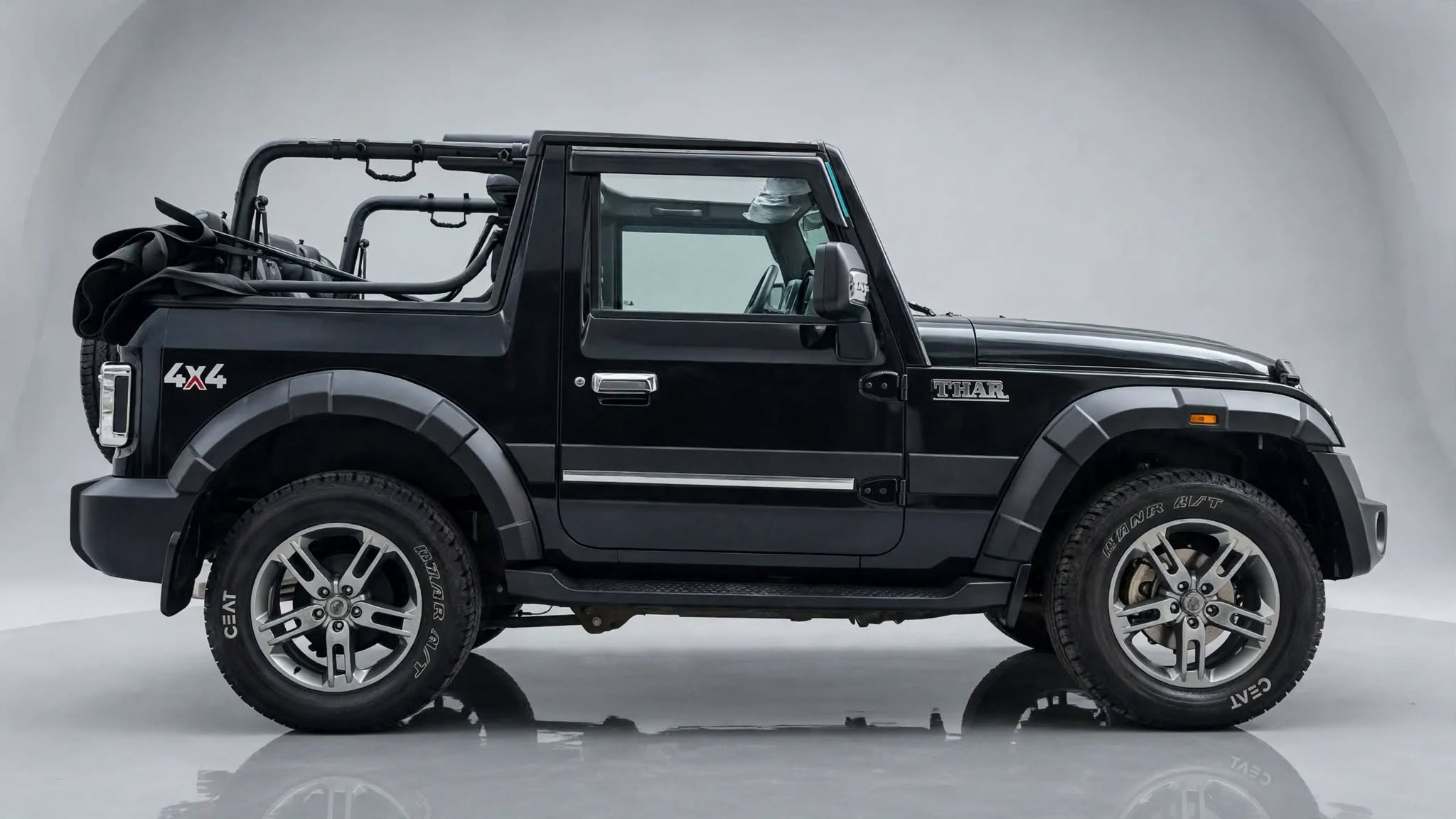
The Thar was born with a roof you could take off. In 2026, Mahindra has decided that the roof should stay exactly where it is.
The new Mahindra Thar OG is now available only with a fixed hardtop. That is interesting because the second-generation Thar launched in 2020 with three roof choices: hardtop, convertible top and soft top. Mahindra later discontinued the soft-top variants in April 2025, and the newly launched Thar OG continues with the hardtop-only approach.
So why did Mahindra leave the soft top behind?
There is probably more to this decision than cost or customer demand.
The soft top was part of the Thar's identity
The soft top made sense on an old-school off-roader.
You could remove or fold the roof, enjoy open-air driving and make the Thar feel closer to its military and adventure roots. When Mahindra launched the second-generation Thar, the company itself marketed the vehicle around freedom and adventure, while offering a convertible top and optional soft top alongside the hardtop.
But there is a problem.
A modern Thar is no longer a basic recreational machine.
It has airbags, ESP, rollover mitigation, modern electronics, better NVH, advanced suspension and increasingly sophisticated safety equipment. The Thar OG now gets up to six airbags, all-disc brakes and an ESP 9.3 system with rollover mitigation.
This means there is a massive overhaul in the engineering.
What happens when a soft-top SUV rolls over?
This is where things get serious.
A soft roof is not automatically unsafe. The important point is that the roof material itself does not provide the same rigid protection as a properly integrated hard structure.
During serious off-road driving, the vehicle can encounter situations where one wheel climbs over an obstacle, the vehicle becomes heavily tilted or the SUV tips sideways.
And Mahindra's own Thar owner's manual does not pretend that rollover is impossible.
It specifically warns that driving off-road at excessive speed, making sharp turns or crossing steep slopes incorrectly can cause the vehicle to roll over and result in serious injury.
The Thar does have a built-in roll cage, which is an important part of occupant protection. The current Thar OG also gets ESP with rollover mitigation as standard.
But rollover protection is not the same thing as saying, "the roof does not matter."
In a rollover, keeping occupants inside the protected survival space becomes critical.
A soft fabric roof can offer weather protection and shade, but it cannot behave like a rigid roof structure when the vehicle lands on its roof.
And once the roof is removed or folded, occupants are even more exposed.
An open vehicle gives the occupants less physical protection from the surrounding environment during a rollover. Rocks, branches, the ground itself and parts of the vehicle can become hazards.
This is also why seat belts remain extremely important in an open off-roader. The objective during a rollover is to keep occupants within the protected area of the vehicle rather than allowing them to be thrown out.
So did Mahindra remove the soft top because it was unsafe?
Mahindra has not publicly said that safety was the reason for discontinuing the soft top.
What we know is that Mahindra discontinued the soft-top variants in April 2025, and the Thar OG launched in September 2026 continues with only the fixed hardtop.
So saying, "Mahindra removed the soft top because it was unsafe" would go beyond the evidence.
But safety could reasonably be one part of the engineering and product decision.
There are several other possible reasons.
1. A hardtop fits the modern Thar better
The Thar has slowly moved away from being a bare-bones off-roader.
The OG gets better NVH insulation, improved suspension, electric power steering, a larger infotainment system, rear AC vents and more premium interiors.
A hardtop works better with that direction.
It helps with:
Noise insulation
Water sealing
Thermal insulation
Cabin refinement
Air-conditioning performance
Structural integration
Interior trim
Roof-mounted equipment
A soft roof belongs naturally to a more rugged, stripped-down version of the Thar.
The current Thar is increasingly becoming a lifestyle SUV that happens to be very capable off-road.
2. The soft top probably had limited demand
This could be one of the biggest commercial reasons.
Most Thar buyers in India are not using their vehicles like a Jeep in the mountains every weekend.
For many owners, the Thar is a lifestyle purchase. It is used for city driving, highways, weekend trips and the occasional trail.
For that customer, a hardtop has obvious advantages.
It is quieter.
It feels more secure.
It handles Indian weather better.
It provides better air-conditioning.
It is easier to live with.
And it looks more substantial.
If relatively few buyers choose the soft top, keeping a separate roof configuration becomes harder to justify.
3. Manufacturing complexity
There is also a simple business question.
Why manufacture two different roof systems if one sells overwhelmingly better?
A soft top needs its own roof structure, fabric, sealing, fastening system and quality checks. It also creates another set of parts that can wear, leak, rattle or require replacement.
For a manufacturer trying to simplify production, a single fixed roof makes life easier.
And the Thar OG is not a minor facelift. Mahindra says it sits on the new M_Glyde 4G platform with higher stiffness, while also getting a revised suspension and other structural and mechanical changes.
So Mahindra had a chance to rethink the entire product.
It chose the hardtop.
4. The Indian climate is not exactly soft-top friendly
This part is less glamorous.
India has heat.
Then rain.
Then dust.
Then more heat.
A convertible roof sounds fantastic when you imagine a cool evening drive through the mountains.
It is less romantic when you are sitting inside the vehicle during a Patna summer afternoon.
The hardtop gives the air-conditioning system a much easier job and provides better protection from heat and rain.
For a daily-driven Thar, that matters.
5. Safety expectations have changed
This may be the most interesting reason.
The original charm of the Thar came from its simplicity.
The modern Thar has moved in the opposite direction.
The Thar OG comes with a built-in roll cage, ESP with rollover mitigation and, on the top variant, six airbags including Mahindra's HPTS side protection system.
The more safety technology Mahindra adds, the more difficult it becomes to treat the roof as simply a removable accessory.
There is now a much bigger safety system around the occupants.
A fixed roof makes the overall package easier to engineer, seal, integrate and validate.
.webp)