
























What is Vehicle Dynamics? Definition, Types, Components and Applications
By Nitesh Yadav • Published on 5 Oct 2026A vehicle may look like one machine when it moves, but hundreds of components are working together to control how it accelerates, brakes, turns and re...
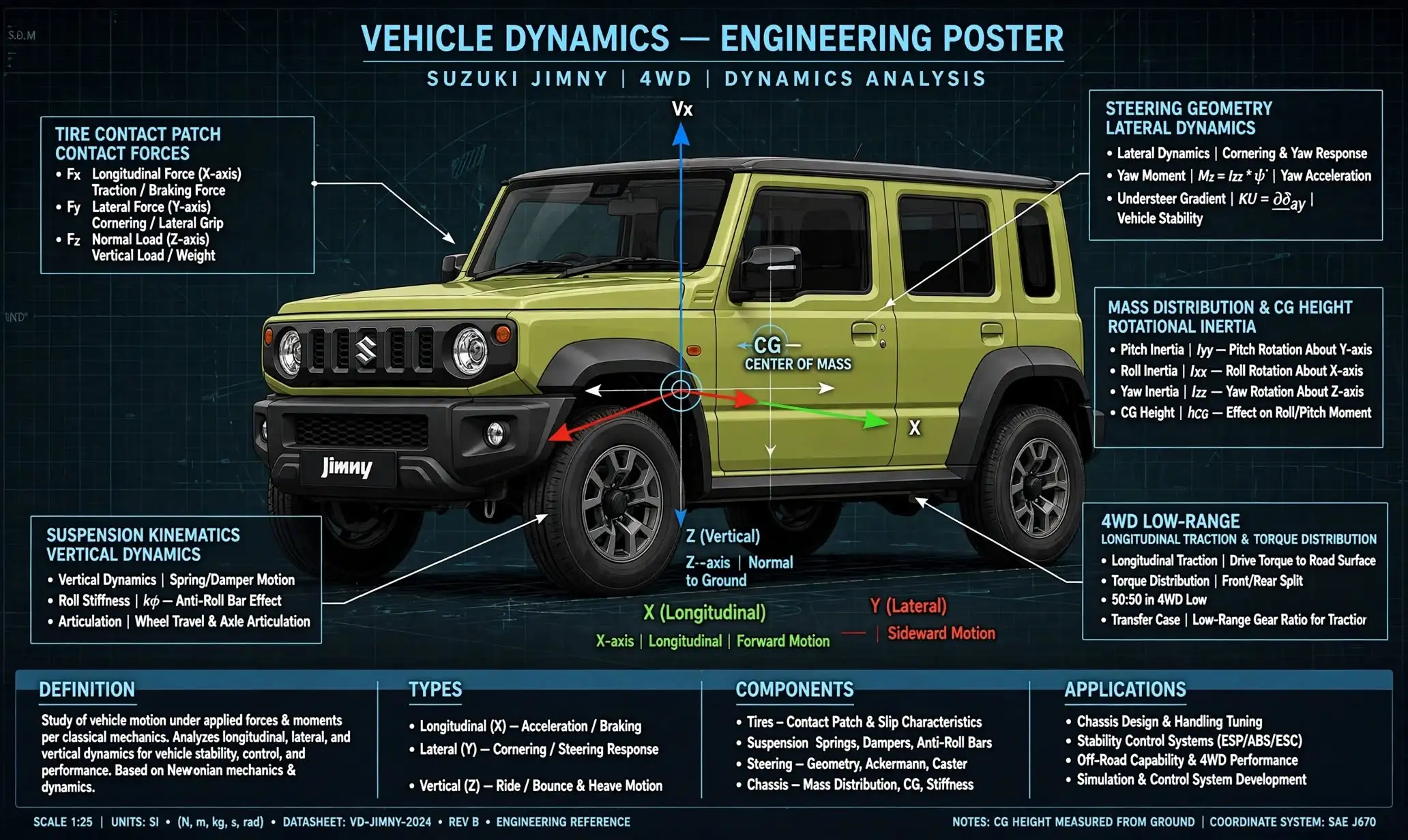
A vehicle may look like one machine when it moves, but hundreds of components are working together to control how it accelerates, brakes, turns and responds to the road. Vehicle dynamics is the branch of automobile engineering that studies how a vehicle moves and how forces acting on the vehicle affect its motion, handling, stability and ride comfort. From the tyres and suspension to the steering, brakes, chassis and centre of gravity, every major system is designed so that the vehicle responds in a predictable way, whether it is accelerating on a straight road, braking suddenly or taking a corner.
Major Subtopics of Vehicle Dynamics
Vehicle dynamics is a broad subject in automobile engineering. It can be divided into several subtopics based on the type of vehicle motion, forces involved, and systems that control the vehicle.
1. Longitudinal Dynamics
Deals with vehicle motion in the forward and backward direction, including acceleration, braking, traction and rolling resistance.
2. Lateral Dynamics
Studies how a vehicle behaves while turning, including cornering forces, slip angle, understeer, oversteer and yaw.
3. Vertical Dynamics
Focuses on the up and down movement of a vehicle caused by road irregularities, suspension movement and tyre behaviour. It is closely related to ride comfort.
4. Weight Transfer
Explains how the load on individual wheels changes during acceleration, braking and cornering.
5. Centre of Gravity
The location and height of the vehicle's centre of gravity affect stability, handling, braking and weight transfer.
6. Roll Centre and Body Roll
Covers how the vehicle body moves during cornering and how suspension geometry controls this movement.
7. Tyre Dynamics
Studies how tyres generate traction and cornering forces through contact with the road.
8. Steering and Handling
Deals with steering response, directional control, yaw behaviour and how a vehicle responds to driver inputs.
9. Braking Dynamics
Covers braking forces, brake bias, brake fade, ABS, EBD and the behaviour of a vehicle during hard braking.
10. Vehicle Stability
Examines how a vehicle maintains control during acceleration, braking and cornering, including systems such as Electronic Stability Control (ESC).
11. Suspension Dynamics
Studies how suspension systems control wheel movement, body movement, road impact and ride comfort.
12. Aerodynamics and Vehicle Dynamics
Explains how aerodynamic drag, downforce and lift influence vehicle stability, handling and high-speed performance.
Longitudinal Dynamics of a Vehicle: Forces, Acceleration and Braking
When a vehicle accelerates, brakes or climbs a hill, several forces act along its length. Longitudinal dynamics is the branch of automobile engineering that studies these forces and their effect on vehicle acceleration, braking and speed. The engine or electric motor provides the driving force, while tyre grip, rolling resistance, aerodynamic drag, road gradient and braking forces determine how the vehicle actually moves.
What is Longitudinal Dynamics?
Longitudinal dynamics deals with the forward and backward motion of a vehicle. It helps engineers understand:
Vehicle acceleration
Braking performance
Traction
Rolling resistance
Aerodynamic drag
Hill climbing
Weight transfer
The basic force balance can be represented as:
Fₜ - Fᵣ - Fᴅ - Fɢ = ma
Here, tractive force moves the vehicle forward, while rolling resistance, aerodynamic drag and gradient resistance oppose its motion.
Major Forces in Longitudinal Dynamics
Tractive Force
Tractive force is generated by the engine or electric motor and transferred to the road through the tyres. It determines how strongly a vehicle can accelerate.
Rolling Resistance
Tyres deform as they roll, creating resistance. Tyre pressure, vehicle weight, tyre construction and road surface affect rolling resistance.
Aerodynamic Drag
Air resistance acts against a moving vehicle and increases with speed. Vehicle shape, frontal area and drag coefficient affect this force.
Gradient Resistance
When a vehicle climbs a slope, gravity acts against its movement. A heavier vehicle needs more force to climb the same gradient.
Braking Force
Braking creates a force opposite to vehicle motion. The available braking force depends heavily on tyre-road grip, which is why systems such as ABS are important.
Longitudinal Dynamics and Weight Transfer
During acceleration, load shifts towards the rear wheels. During braking, load shifts towards the front wheels. This longitudinal weight transfer changes the grip available at each axle and affects acceleration, braking and vehicle stability.
Longitudinal Dynamics in EVs
Electric vehicles add another important element, regenerative braking. The electric motor can work as a generator during deceleration, converting some kinetic energy into electrical energy and sending it back to the battery.
Why is Longitudinal Dynamics Important?
Longitudinal dynamics is used in:
Engine and motor sizing
Gear ratio selection
Brake design
Vehicle performance testing
Traction control
Cruise control
EV range and regenerative braking
ADAS development
In simple terms, longitudinal dynamics explains why a vehicle moves forward, how quickly it accelerates, and what makes it slow down.
Lateral Dynamics of a Vehicle: Cornering Forces, Slip Angle and Handling
A vehicle does not only move forward. The moment you turn the steering wheel, the tyres, suspension and chassis start dealing with forces acting sideways. Lateral dynamics is the branch of automobile engineering that studies how a vehicle behaves during cornering and other side-to-side movements. It explains cornering force, tyre slip, slip angle, yaw, understeer, oversteer and vehicle handling.
What is Lateral Dynamics?
Lateral dynamics deals with the sideways motion and behaviour of a vehicle, especially when it is turning.
It helps engineers understand:
Cornering
Steering response
Tyre grip
Slip angle
Yaw motion
Understeer and oversteer
Vehicle stability
Lateral dynamics becomes particularly important at higher speeds, during sudden steering inputs and when a vehicle is driven around corners.
Cornering Force
When a vehicle turns, the tyres generate a sideways force that helps change the direction of the vehicle.
This is called cornering force or lateral tyre force.
The force depends on factors such as:
Tyre-road friction
Vehicle speed
Tyre characteristics
Vertical load on the tyre
Slip angle
Without sufficient lateral tyre force, the vehicle cannot follow the intended corner.
What is Slip Angle?
A tyre does not always travel exactly in the direction it is pointing.
The angle between the direction in which the tyre is pointing and the actual direction in which it is travelling is called the slip angle.
A small slip angle allows the tyre to generate lateral force.
As the slip angle increases, lateral force generally increases until the tyre reaches its grip limit. Beyond that point, the tyre can begin to slide.
Yaw Motion
When a vehicle turns around a vertical axis, it experiences yaw.
The rate at which this rotation happens is called yaw rate.
Engineers study yaw rate to understand how quickly a vehicle responds to steering input and whether it remains stable during a turn.
Understeer and Oversteer
Two important handling behaviours in lateral dynamics are understeer and oversteer.
Understeer: The vehicle turns less than the driver expects, so the driver needs more steering input.
Oversteer: The rear of the vehicle tends to move outward, causing the vehicle to turn more than expected.
Vehicle manufacturers tune suspension, tyres, steering and weight distribution to achieve predictable handling.
Factors Affecting Lateral Dynamics
Several factors influence how a vehicle behaves while cornering:
Tyre size and characteristics
Vehicle speed
Centre of gravity
Weight distribution
Suspension geometry
Steering system
Track width
Wheelbase
Road surface
Aerodynamic downforce
Why is Lateral Dynamics Important?
Lateral dynamics plays a major role in:
Vehicle handling
Steering design
Suspension tuning
Tyre development
Vehicle stability
Motorsport
ADAS
Electronic Stability Control
Autonomous driving
In simple terms, lateral dynamics explains what happens when a vehicle turns, how the tyres generate cornering grip, and why one vehicle can feel stable while another feels nervous or difficult to control.
/Alto VXI Plus 6.webp)