












V2V Communication Is Coming to Indian Cars in 2028: Here Is How Your Car Will Talk to Other Vehicles
By Nitesh Yadav • Published on 9 Aug 2026Your car may soon warn you about a crash that you cannot even see. Imagine driving through heavy fog on a highway. Visibility is terrible. You approa...
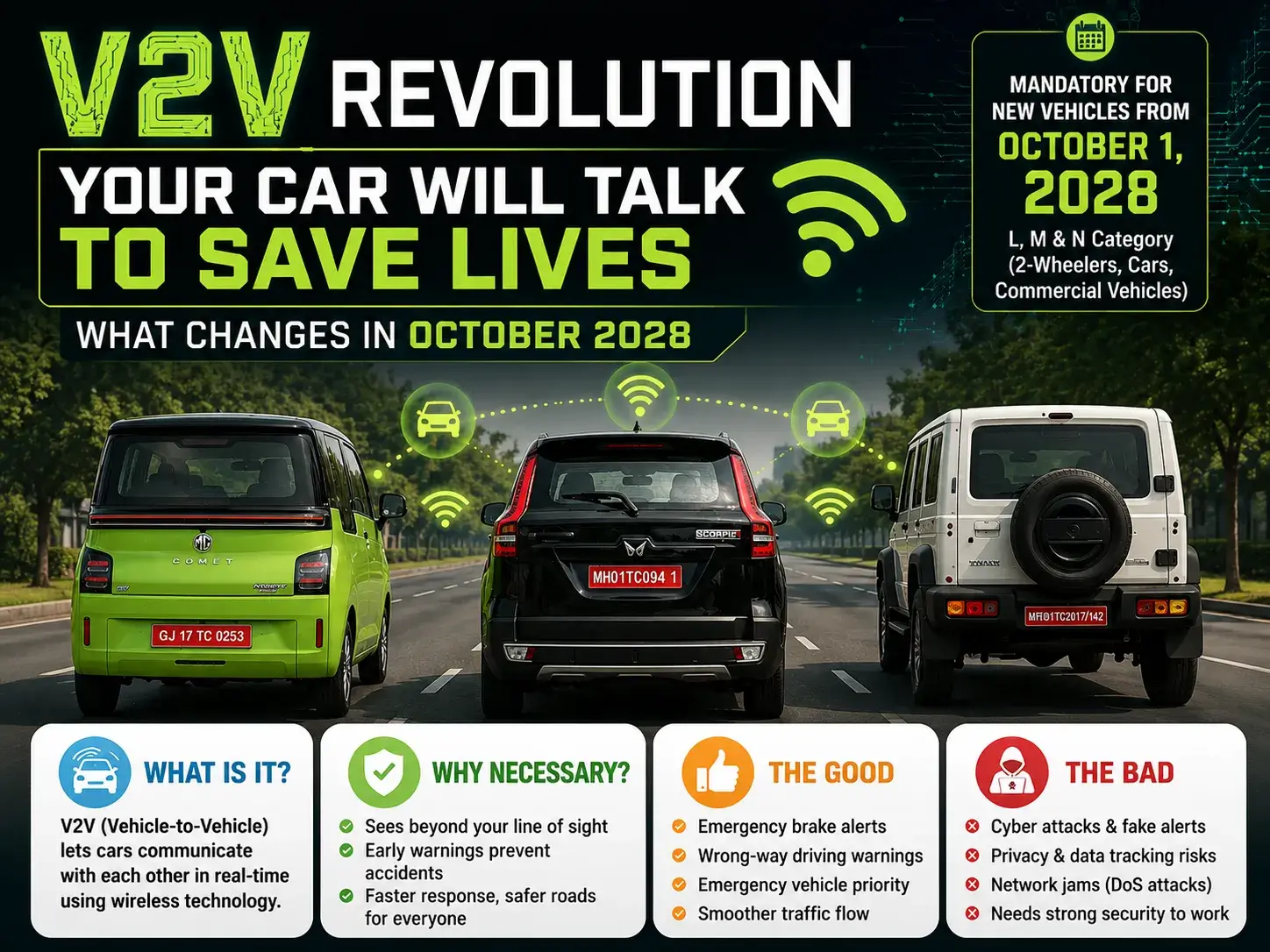
Your car may soon warn you about a crash that you cannot even see.
Imagine driving through heavy fog on a highway. Visibility is terrible. You approach a blind curve and suddenly your car flashes a warning: "Emergency braking ahead, 300 metres."
You cannot see the vehicles involved. Your camera cannot see them either.
But another vehicle has already detected the danger and sent the information to your car.
This is the idea behind Vehicle-to-Vehicle, or V2V, communication.
India is preparing for a major change in how vehicles communicate with each other. The Ministry of Road Transport and Highways, MoRTH, has proposed changes to the Central Motor Vehicles Rules that would make V2V communication systems mandatory for newly manufactured L, M and N-category vehicles from October 1, 2028.
That covers a huge part of India's road traffic, including two-wheelers, passenger vehicles and commercial vehicles.
If implemented as proposed, your next car may have a new safety system that does something today's ADAS systems cannot do on their own.
It could receive information about danger before its own sensors can see it.
What is V2V communication?
V2V stands for Vehicle-to-Vehicle communication.
The basic idea is surprisingly simple.
Vehicles equipped with the technology can exchange information with other nearby vehicles. This can include data such as speed, direction, position and sudden braking events.
Your vehicle can then use this information to identify potential hazards.
Think of it as a conversation between vehicles.
Your car could effectively say:
"I am slowing down suddenly."
Another car behind you receives that information and can warn its driver.
A third vehicle may receive the same warning even if the second vehicle is blocking its view.
That is where V2V can become much more powerful than traditional vehicle safety systems.
Why V2V is different from ADAS
Modern cars already use cameras, radar and other sensors for Advanced Driver Assistance Systems, or ADAS.
These systems can detect vehicles, pedestrians, lane markings and obstacles around the car.
But there is one major limitation.
Your sensors can only detect what they can physically observe.
A truck can block a camera.
A sharp corner can hide a vehicle.
Fog can reduce visibility.
Heavy rain can make sensors less effective.
V2V works differently.
Instead of waiting for your car to see the danger, information can come directly from another vehicle.
This gives connected vehicles a kind of digital line of sight beyond their physical sensors.
It is not literally X-ray vision, of course. Sadly, your car will not suddenly become Superman.
But it can know about events that are outside its immediate view.
What will V2V do from October 2028?
If the proposed rules are implemented as planned, factory-fitted On-Board Units, or OBUs, will allow vehicles to communicate with other connected vehicles.
This could enable several safety functions.
Emergency braking alerts
Imagine three vehicles ahead of you suddenly braking.
Your vehicle cannot see the first vehicle because a large SUV is blocking your view.
With V2V, the braking information can travel through the connected vehicles.
Your car can then warn you before the danger becomes visible.
This could give the driver additional reaction time.
And on highways, even a few extra seconds can matter.
Forward collision warnings
V2V could also help identify sudden slowdowns and potential collision risks.
If traffic ahead comes to a sudden stop, connected vehicles can transmit that information backward.
Your car could then warn you before the traffic becomes visible around a bend or behind another vehicle.
Wrong-way vehicle warnings
One of the more interesting applications is wrong-way driving detection.
If a connected vehicle is travelling in the wrong direction, information about its position and direction can be shared with nearby vehicles.
A driver approaching the danger could receive a warning before the wrong-way vehicle becomes visible.
That could be particularly useful on highways and divided roads.
Emergency vehicle alerts
V2V could also improve how ambulances and fire engines move through traffic.
Instead of waiting until you hear a siren or see flashing lights in your mirror, your car could receive information that an emergency vehicle is approaching.
The driver could then get more time to move aside.
In theory, this could make the emergency response system more efficient, particularly on congested roads.
How will cars from different companies communicate?
This is where standards become important.
Imagine a Maruti Suzuki travelling alongside a Hyundai, Tata, Mahindra and Toyota.
If every manufacturer created its own communication system, connected traffic would quickly become a technological mess.
One company's car might speak one language while another speaks something completely different.
The proposed system uses AIS-230, an Indian automotive technical standard intended to provide a common framework for V2V communication.
The technology mentioned for this system is Cellular Vehicle-to-Everything, or C-V2X.
The important point is that vehicles from different manufacturers need to be able to understand the same safety messages.
That interoperability is critical.
A connected road is useful only when the cars on it can actually communicate with each other.
Does V2V need mobile internet?
This is one of the most interesting parts of the technology.
Direct vehicle-to-vehicle communication does not necessarily need a cellular tower or an internet connection.
Vehicles can communicate directly over the designated spectrum used for V2X communication.
That means a car does not have to send every emergency message to a remote server and wait for a response.
The communication can happen locally between nearby vehicles.
That matters because safety warnings need to arrive extremely quickly.
If your car has to send a message to a distant server, wait for the server to process it and then receive the response, the system introduces additional delay.
For a safety-critical warning, milliseconds matter.
Which frequency will V2V use?
The proposed system uses the 5.875 GHz to 5.925 GHz band for V2X communication.
The Department of Telecommunications has also taken steps regarding the use of this spectrum for such applications.
The use of a dedicated spectrum range is important because connected vehicles need a reliable communication channel.
Your car does not need to be streaming YouTube when it is trying to warn you about a vehicle that has just slammed on its brakes.
Will every vehicle on the road be connected?
No, at least not immediately.
This is one of the biggest challenges with V2V.
The system becomes more useful as the number of connected vehicles increases.
Imagine you have a V2V-equipped car travelling behind an old vehicle that does not have the technology.
The older vehicle cannot send V2V messages.
So the connected ecosystem will probably develop gradually.
Initially, you may have a mixture of connected and non-connected vehicles.
Over time, as more new vehicles enter the road, the percentage of connected vehicles should increase.
That means the benefits of V2V could become stronger year after year.
Will V2V make cars safer?
Potentially, yes.
But V2V should not be treated as a replacement for the driver, brakes, airbags, radar or cameras.
It is another layer of safety.
A connected car could receive information about a hazard, while its radar and camera independently detect the same vehicle.
That gives the vehicle multiple sources of information.
This is especially useful when physical sensors have limitations.
For example:
Camera: "I cannot see beyond the truck."
Radar: "I cannot detect the vehicle around the corner."
V2V: "The vehicle ahead just performed emergency braking."
That combination could give advanced safety systems a much better understanding of what is happening around the vehicle.
But there is a serious problem: cybersecurity
There is another side to connecting millions of vehicles.
Every connected device creates a potential attack surface.
If vehicles are exchanging safety information wirelessly, manufacturers and regulators have to make sure that information cannot be easily manipulated.
Otherwise, the technology designed to prevent crashes could potentially create new risks.
What happens if someone sends a fake emergency warning?
Consider this scenario.
You are driving at 80 kmph.
Suddenly your dashboard says:
"Emergency braking ahead."
You panic and slam on the brakes.
But there is no accident.
Someone has sent a fake V2V message.
This is known as spoofing.
A malicious device could potentially attempt to send false information into the connected vehicle network.
If enough vehicles believe the fake warning, the consequences could be serious.
Drivers could brake unnecessarily, change lanes suddenly or create traffic congestion.
This is why authentication of V2V messages is extremely important.
Could hackers track your car?
Privacy is another concern.
Connected vehicles may exchange information related to their location, speed and direction.
That data is useful for safety systems.
But it can also become sensitive.
Nobody wants a vehicle communication system to quietly become a real-time tracker.
Regulators and manufacturers will therefore need strong rules around what information is transmitted, how it is protected and whether it can be linked back to an individual vehicle or driver.
What is a Denial-of-Service attack?
Another possible threat is a Denial-of-Service, or DoS, attack.
In simple terms, an attacker could try to flood the communication channel with large amounts of useless traffic.
The goal would be to make legitimate safety messages harder to receive.
Imagine a crowded room where everyone suddenly starts shouting.
The emergency announcement is still being made, but nobody can hear it.
A similar problem could happen in a wireless communication system.
For V2V, that could be particularly dangerous.
What is a Sybil attack?
A Sybil attack is another concern for connected vehicle networks.
In this case, one compromised device could pretend to be many different vehicles.
For example, instead of sending one false message, an attacker could make it appear as if ten or fifty different vehicles are reporting the same event.
That could make false information appear more believable.
A robust security system therefore needs to know not only what message was sent, but also whether the source of that message can be trusted.
How much will V2V add to the price of a car?
The proposed technology is expected to add hardware and system costs to vehicles.
Estimates have placed the additional hardware cost at roughly ₹5,000 to ₹7,000 per vehicle, although the final cost to consumers can depend on implementation, economies of scale, software and manufacturer decisions.
For a ₹10 lakh car, that may not sound huge.
But multiply that cost across millions of vehicles and the number becomes significant.
It will also raise an interesting question for entry-level cars.
Will manufacturers absorb the cost?
Will it be passed directly to buyers?
Or will V2V become part of a wider connected safety package?
Those answers will become clearer as implementation approaches.
What does October 2028 mean for someone buying a car today?
If you are buying a car before 2028, you do not need to panic.
V2V is not going to make today's car suddenly unsafe.
Traditional safety systems such as airbags, ABS, ESC, ADAS and strong crash protection will continue to matter.
But if the proposed rules take effect, the automotive market will gradually move towards a different model.
Your car will increasingly become a connected participant in the road environment.
Instead of operating alone, it will exchange safety information with nearby vehicles.
Will V2V replace the driver?
No.
And it should not.
The best way to think about V2V is as an additional information layer.
Your eyes see the road.
Your cameras and radar monitor the surroundings.
Your vehicle's electronic systems process that information.
V2V adds another source of information from vehicles around you.
The driver still needs to make decisions.
A warning does not automatically mean you should slam the brakes.
It means the car has given you information that you may not have had otherwise.
India's V2V future could be much bigger than crash warnings
The biggest potential of V2V may not even be emergency braking.
Once enough vehicles are connected, the same communication infrastructure could support broader intelligent transport applications.
Traffic congestion warnings could be shared between vehicles.
Road hazards could be reported.
Emergency vehicles could receive better priority.
Connected traffic signals could communicate with vehicles.
Road authorities could receive real-time information about incidents.
Eventually, the road itself could become part of the connected network.
That is where V2V starts moving from a safety feature to a broader vehicle-to-everything ecosystem.
The biggest challenge will be trust
The technology itself is only half the battle.
For V2V to work properly, manufacturers need common standards, reliable hardware, fast communication, strong cybersecurity and clear privacy rules.
Most importantly, drivers need to trust the warnings.
If drivers repeatedly receive false alerts, they will start ignoring them.
That is the worst possible outcome for a safety system.
The goal should therefore be simple:
When your car warns you about danger, you should have a very good reason to believe it.
October 2028 could change the way we think about cars
For more than a century, cars have largely operated as individual machines.
You drive your car.
The driver ahead drives theirs.
The truck coming from the opposite direction has no idea what your vehicle is doing.
V2V changes that model.
Your car could know that another vehicle has suddenly braked.
It could know that an emergency vehicle is approaching.
It could receive information about a hazard hidden around a corner.
And it could warn you before your own sensors can see the danger.
That is a major shift.
By October 2028, if the proposed rules are implemented as planned, the question may no longer be whether your car can see the road. It may also be whether your car can listen to it.