

















The Great Indian Tirri Problem: E-Rickshaw Epidemic
By Zeeshan A Aqudus • Published on 24 Sept 2026If a Rolls-Royce Ghost passes your way, it will get your attention because it is expensive. If a Ferrari Purosangue zooms past you, you will notice it...
.webp)
If a Rolls-Royce Ghost passes your way, it will get your attention because it is expensive. If a Ferrari Purosangue zooms past you, you will notice it because it is fast. But there is one more vehicle on Indian roads that demands your attention because its passenger is still 40 metres away and for that passenger, it has blocked your way.
It is none other than the great Indian E-Rickshaw!
I have a cycle, a Suzuki Access, a Zen Estilo and a Grand Vitara. Somehow, all four have had an encounter with an e-rickshaw. My cycle has been hit multiple times while I was riding it. The Access lost its rear light once. The Zen Estilo got a damaged bumper twice. My Grand Vitara has several ORVM scratches and broken hinges on the rear light.
.webp)
The total repair bill has crossed ₹10,000. These are small incidents caused by E-Rickshaws squeezing through gaps. Today, the bigger problem is not the e-rickshaw itself, but the lack of proper routes, designated stops and traffic management. They pick up passengers almost anywhere, stop wherever someone waves and often wait in places that block lanes.
When hundreds compete for passengers, junctions, T-roads and markets can quickly turn into unofficial e-rickshaw stands. One stops, another stops behind it, and soon the road becomes difficult for everyone.
Cars get stuck, bikes squeeze through gaps, pedestrians move into traffic and horns become the unofficial traffic control system. E-rickshaws were meant to solve short-distance mobility, but without proper planning, the system around them can make urban roads harder to use.
The Collective Loss of Time and Money if an E-rickshaw waits for 30 seconds
Scenario: 20 e-rickshaws stop for 30 seconds each in the same route
Assume that every time an e-rickshaw stops in the middle of the road, it creates a short queue of:
5 cars
15 motorcycles
Average 1.5 people per car
Average 1 person per motorcycle
Each vehicle loses 30 seconds
Petrol assumed at ₹100/litre
Average stationary fuel consumption assumed at 0.6 L/hour for a car and 0.1 L/hour for a motorcycle
|
Metric |
Cars |
Motorcycles |
Total |
|---|---|---|---|
|
Vehicles affected per stop |
5 |
15 |
20 |
|
Number of e-rickshaw stops |
20 |
20 |
20 |
|
Total vehicle-stops |
100 |
300 |
400 |
|
People per vehicle |
1.5 |
1 |
175 people across all stops |
|
Delay per vehicle |
30 sec |
30 sec | |
|
Total person-time lost |
75 min |
150 min |
225 person-minutes |
|
Total time lost |
3.75 person-hours | ||
|
Fuel consumed while waiting |
~0.5 L |
~0.5 L |
~1 litre |
|
Fuel cost |
~₹50 |
~₹50 |
~₹100 |
If 20 e-rickshaws stop for only 30 seconds each, and each stop holds up just 5 cars and 15 motorcycles, the combined delay can reach around 3.75 person-hours.
The fuel loss would be roughly 1 litre, or about ₹100 at ₹100/litre.
And remember, this assumes only 20 vehicles are affected by each stop.
The e-rickshaw may stop for 30 seconds. The traffic behind it can pay for those 30 seconds for several minutes.
We Already Had a Traffic Problem and E-Rickshaws added to it massively.
Indian cities were already struggling with traffic before e-rickshaws became common. Narrow roads, poor parking, badly designed junctions and mixed traffic had already created a mess. Then came the e-rickshaw, offering cheap last-mile transport.
On paper, it made sense. It has easy entry and exit, a small turning radius, low running costs and can carry more people than a motorcycle while entering narrow lanes.
But on Indian roads, it occupies an awkward middle ground.
An e-rickshaw is too wide to behave like a bike, yet too small to be treated like a car. It moves through gaps like a two-wheeler, takes road space like a car and often stops like a bus. When moving it can squeeze through traffic, but when it stops, it can quickly become a roadblock.
.webp)
Are E-Rickshaws Actually Approved by ARAI?
It is important to add some clarity here because blaming the entire problem on vehicle regulation would be misleading.
E-rickshaws are not completely unregulated vehicles. ARAI carries out type approval and homologation for e-rickshaws and e-carts under India’s Central Motor Vehicle Rules. The rules also cover key areas such as braking, lighting, signalling and other technical requirements.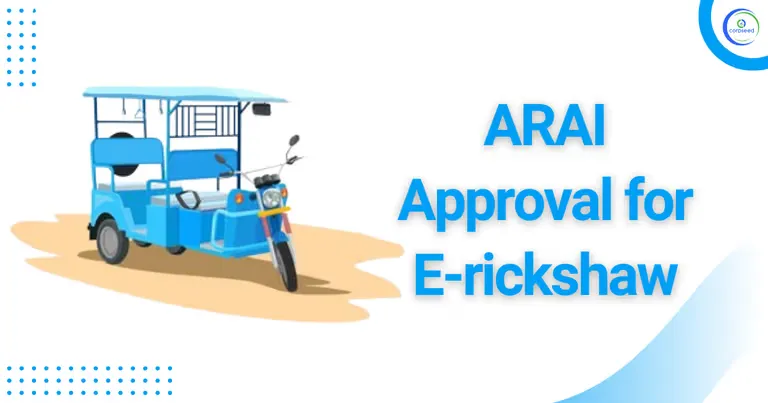
So the question is not simply, "Does ARAI approve e-rickshaws?"
The bigger question is, "What happens after an approved e-rickshaw reaches the road?"
Type approval checks whether the vehicle meets technical and regulatory requirements. It does not decide how many e-rickshaws should use a road, where they should stop, or whether they should form an informal stand at a junction.
That is where vehicle regulation ends and urban mobility design begins.
India needs to look beyond whether a vehicle is legal and ask whether the system around it is designed properly.
Why Has the Government Not Been Able to Fix the E-Rickshaw Problem?
In Delhi, battery rickshaws were almost absent in 2010 but reached an estimated 100,000 by 2013. By October 2014, the government had formally defined the e-rickshaw category. Since then, the vehicle has spread from metro stations and markets to Tier-II and Tier-III cities.
The growth has been huge. E-3W sales rose from around 92,000 units in FY2018 to more than 6.3 lakh in FY2024, while the e-rickshaw market reportedly grew at about 53% CAGR between FY2019 and FY2024.
So why did regulation struggle to keep pace?
Because the e-rickshaw solved two problems at once: mobility and employment.
For passengers, it offered cheap short-distance travel and easy access to narrow roads. For workers, it offered a relatively simple path to self-employment. Buy or finance an e-rickshaw, find passengers and start earning.
That makes regulation far more complicated than regulating private cars. Restricting thousands of e-rickshaws also affects thousands of livelihoods.
This does not mean cities cannot regulate them. It means the answer cannot simply be, "There are too many e-rickshaws, remove them."
The real questions are local:
Where can they operate?
Where can they stop?
How many should serve a route?
Where should passengers board?
What happens when 50 e-rickshaws compete for passengers at one junction?
These are questions of transport planning, permits, enforcement, traffic management and road design.
The result is an awkward compromise. Cities cannot treat e-rickshaws like cars, bicycles or buses because they serve a different mobility and employment role.
The problem is that in many places, the e-rickshaw grew faster than the urban system built to manage it.
How Do We Actually Fix the E-Rickshaw Problem?
I studied Vehicle and Mobility Design at UPES, Dehradun. I came across the book, The End of Automobile Dependence: How Cities Are Moving Beyond Car-Based Planning by Peter Newman and Jeffrey Kenworthy.
The basic idea was fascinating. What if we designed cities in such a way that people simply did not need cars for most of their daily lives? That sounds almost radical in India, where we have spent decades designing cities around roads, parking and vehicles. But the idea itself is not complicated. If homes, schools, offices, shops, healthcare and public transport are close enough, people can walk, cycle or use public transport instead of depending on a private vehicle for every small trip.
However, the city has to be designed for it.
You cannot build a city where everything is 7 kilometres away and then complain that people need a vehicle to cover the last mile.
This is why ideas such as the five-minute city are interesting. NEOM's original concept for THE LINE, for example, promises daily essentials within a five-minute walk, with high-speed transit handling longer journeys.
THE LINE has since faced major questions over cost, scale and implementation, with its original vision reportedly being significantly scaled back. That does not mean the five-minute-access principle is wrong. It shows how difficult it is to translate an extremely controlled urban concept into reality.
And Indian cities are nowhere near being designed like that.
Our roads grew organically. Markets expanded into roads. Residential colonies appeared around existing settlements. Offices moved somewhere else. Schools created morning traffic. Railway stations became informal transport hubs. And then we added thousands of e-rickshaws to connect all these disconnected pieces.
So I don't think the answer is to simply remove e-rickshaws.
We need to manage them as a mobility system.
Give the E-Rickshaw a Digital Identity
One simple intervention could be digital fare collection.
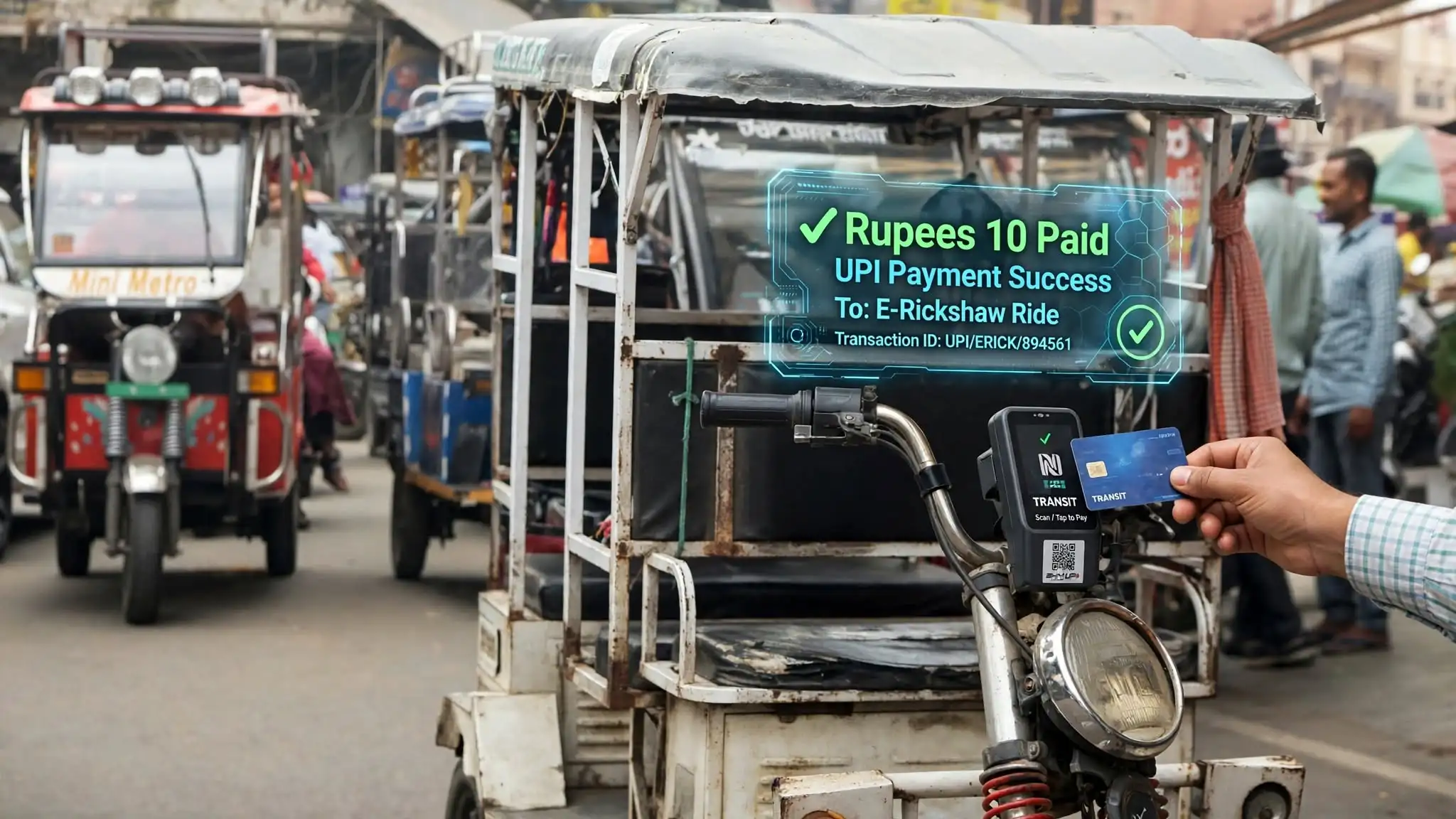
AI Edited Image*
We already have FASTag for toll payments. It uses an RFID tag linked to an account, allowing the toll amount to be deducted electronically without stopping at the toll plaza.
An e-rickshaw could have a registered driver ID and a digital fare account. The passenger could have a common mobility card, similar in concept to a metro smart card.
The driver enters the fare or selects the destination fare on a small device.
The passenger taps the card.
The fare is deducted.
Done.
The same system could also create a digital trail of trips, routes and vehicle activity. It could help authorities understand which routes are overloaded, where passengers are being picked up and where e-rickshaws are repeatedly gathering.
The card does not solve traffic by itself.
But data can.
If 2,000 e-rickshaws are repeatedly converging on the same three junctions between 8 AM and 10 AM, the city should know that. Today, traffic management often begins with someone standing at the junction and discovering the problem with their own eyes.
Regulate the Stopping, Not Just the Vehicle
The biggest problem with an e-rickshaw is often not that it exists.
It is where it stops.
A bus stopping at a designated bus stop is transport.
A bus stopping in the middle of a junction is an obstruction.
The same logic should apply to e-rickshaws.
Create designated pickup points. Keep junctions, turns and narrow stretches as no-stopping zones. Give each route proper pickup areas. If an e-rickshaw wants to collect passengers, it should move into the designated stopping zone instead of treating the middle of the road as its personal railway platform.
This is where traffic policing becomes extremely important.
There are already legal provisions dealing with obstruction and traffic violations. Section 201 of the Motor Vehicles Act specifically deals with penalties for causing obstruction to the free flow of traffic.
But a rule only changes behaviour when the driver believes the rule will actually be enforced.
If an e-rickshaw blocks a junction for 30 seconds and nothing happens, the driver learns something.
If the same behaviour repeatedly results in a meaningful challan, and repeated violations lead to stronger action, the driver learns something else.
Road behaviour is partly a design problem and partly a consequence problem.
You cannot expect traffic discipline from a system where breaking the rule is consistently cheaper than following it.
Do Not Ban the E-Rickshaw. Give It a Job.
The e-rickshaw should not be expected to behave like every other vehicle.
Its greatest value is as a feeder.
Railway station to neighbourhood.
Metro station to residential colony.
Main road to inner streets.
Bus terminal to market.
Short-distance trips where running a full-size bus would make little economic sense.
That is where the e-rickshaw makes sense.
The mistake is allowing the feeder vehicle to become the entire public transport system.
A city should know how many e-rickshaws a particular corridor can absorb, where they should operate and where they should hand passengers over to buses, metro or walking routes.
This is not about making the e-rickshaw disappear.
It is about making the road understand what the e-rickshaw is supposed to do.
Because right now, in many Indian cities, the e-rickshaw has been given a steering wheel, a passenger seat and almost an entire urban transport system to figure out by itself.
And that is not mobility design.
That is outsourcing urban planning to whoever arrives at the junction first.
/Alto VXI Plus 6.webp)