























Ownership Cost of Maruti Fronx After 3 Years: Fuel, Service & Resale Revealed
By Gaurav Cyril • Published on 21 Sept 2026Buying a car for ₹10 lakh is easy. Finding out where that ₹10 lakh went three years later is the interesting part. The Maruti Fronx has built its rep...
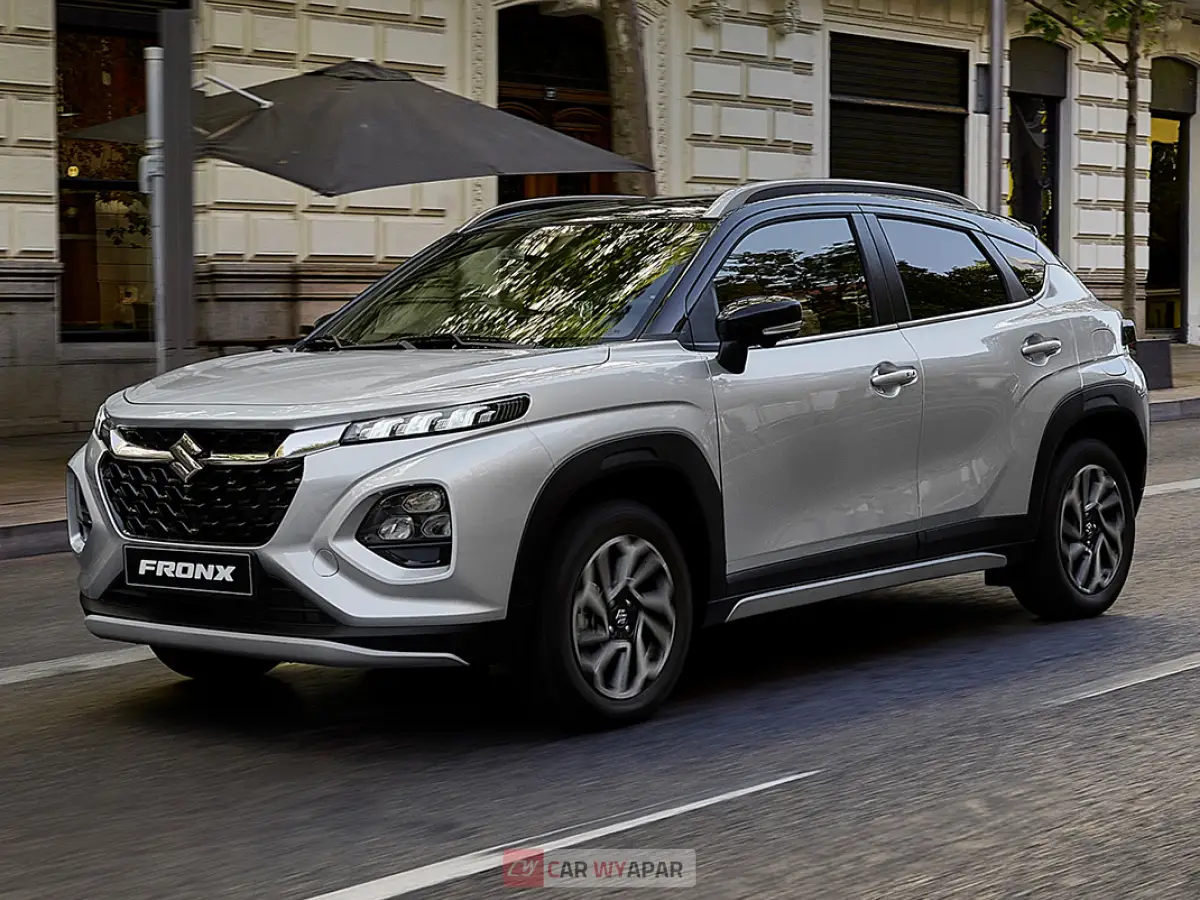
Buying a car for ₹10 lakh is easy. Finding out where that ₹10 lakh went three years later is the interesting part.
The Maruti Fronx has built its reputation around low running costs, good fuel economy and Maruti's wide service network. But how much does it actually cost to own one for three years?
For this calculation, let's take a petrol Fronx driven 30,000 km in three years, or about 10,000 km annually. We will look at fuel, scheduled servicing and depreciation separately, because resale value is the part that can make a big difference to your real ownership cost.
The 3-Year Maruti Fronx Ownership Cost
For a realistic calculation, we are using the 1.2-litre petrol Fronx as the reference car.

The official brochure lists fuel efficiency of 21.79 km/l for the manual and 22.89 km/l for the AMT.
For the calculation below, we use 21 km/l in real-world mixed driving and petrol at ₹100 per litre. Your actual figure will change with traffic, driving style and fuel prices.
|
Cost over 3 years |
Estimated amount |
|---|---|
|
Distance covered |
30,000 km |
|
Average real-world mileage |
21 km/l |
|
Petrol consumed |
~1,429 litres |
|
Fuel cost |
~₹1.43 lakh |
|
Scheduled service |
~₹11,300 |
|
Insurance renewals |
Variable |
|
Tyres and unexpected repairs |
Excluded |
|
Fuel + scheduled service |
~₹1.54 lakh |
The important number here is ₹1.54 lakh.
That is what you spend on fuel and scheduled maintenance for 30,000 km under these assumptions.
Fuel Is Still the Biggest Running Expense
At 21 km/l, covering 30,000 km requires roughly 1,429 litres of petrol.
At ₹100 per litre, that comes to around ₹1.43 lakh over three years.
That works out to:
₹4.76 per km for fuel.
If your Fronx delivers closer to its official 21.79 km/l figure, the fuel bill falls further. Maruti quotes up to 22.89 km/l for the 1.2-litre AMT.
But using the ARAI figure for an ownership calculation can make the numbers look prettier than real life.
Traffic does not care about ARAI.
Neither does your right foot.
So using 21 km/l gives us a more practical estimate.
Fronx Service Cost Is Surprisingly Low
This is where the Fronx makes a strong case for itself.
V3Cars estimates the periodic service cost of the 1.2-litre petrol Fronx at around ₹11,307 up to 30,000 km, based on its service-cost data.
That breaks down roughly like this:
|
Service |
Odometer |
Estimated cost |
|---|---|---|
|
Initial service |
1,000 km |
₹2,317 |
|
Annual service |
10,000 km |
₹2,317 |
|
Second year |
20,000 km |
₹2,317 |
|
Third year |
30,000 km |
₹4,356 |
|
Total |
30,000 km |
₹11,307 |
These are estimates, not a guaranteed invoice. Maruti itself says service cost varies by model, running and odometer reading and provides an official service-cost calculator.
Maruti also offers Smart Maintenance Plans that can cover scheduled maintenance for fixed periods and mileage.
So the Fronx does not need a huge maintenance budget during its first three years if you stick to scheduled maintenance.
What Does the Fronx Cost Per Month to Run?
Let's remove the purchase price for a moment.
With 30,000 km over three years:
Fuel: ~₹1.43 lakh
Scheduled maintenance: ~₹11,300
Total:
~₹1.54 lakh
Spread across 36 months, that is approximately:
₹4,280 per month
That sounds pretty reasonable for a petrol SUV.
But there is a big expense missing.
Depreciation.
The Resale Value Changes the Entire Calculation
This is where car ownership becomes more interesting.
You do not really "lose" the entire purchase price when you sell the car. You recover part of it through resale.
The question is how much.
A 2026 Autocar India and Spinny used-car study found that the average new car depreciated by around 33% after three years across the wider Indian market. The same study found that Maruti Suzuki models were among the stronger value-retaining brands.
A separate 2026 analysis of the sub-compact SUV segment found that the Fronx held its value particularly well in the short term, although the study noted that its used-market data was more limited because the model is relatively new.
That means we should not pretend that there is one guaranteed Fronx resale percentage.
Instead, let's use a rough 30% depreciation assumption for a clean, three-year-old car with around 30,000 km.
What Happens to a ₹10 Lakh Fronx After 3 Years?
Suppose your effective purchase cost is ₹10 lakh.
At 30% depreciation:
Estimated resale value = ₹7 lakh
So:
Purchase value: ₹10 lakh
Estimated resale value: ₹7 lakh
Depreciation: ₹3 lakh
Now add the running expenses:
|
Ownership expense |
3-year estimate |
|---|---|
|
Depreciation |
₹3.00 lakh |
|
Fuel |
₹1.43 lakh |
|
Scheduled service |
₹0.11 lakh |
|
Total |
₹4.54 lakh |
That gives an estimated ownership cost of around:
₹4.54 lakh over three years
Or roughly:
₹12,600 per month
And around:
₹15.1 per km
This excludes insurance, financing interest, parking, tolls, tyres, accident repairs and accessories.
So it is not the total cash cost of owning the car. It is a way to understand the major ownership costs.
What If You Drive More?
This is where the Fronx's fuel efficiency starts working harder for you.
Assuming the same 21 km/l real-world mileage and ₹100/litre petrol:
|
Annual running |
3-year distance |
Approx. fuel cost |
|---|---|---|
|
5,000 km/year |
15,000 km |
₹71,400 |
|
10,000 km/year |
30,000 km |
₹1.43 lakh |
|
15,000 km/year |
45,000 km |
₹2.14 lakh |
|
20,000 km/year |
60,000 km |
₹2.86 lakh |
This is why the Fronx becomes more attractive for someone who drives regularly.
A car that spends most of its life parked does not get much opportunity to repay you through fuel efficiency.
And What About the CNG Fronx?
The CNG version changes the equation.
Maruti quotes 28.51 km/kg for the Fronx CNG.
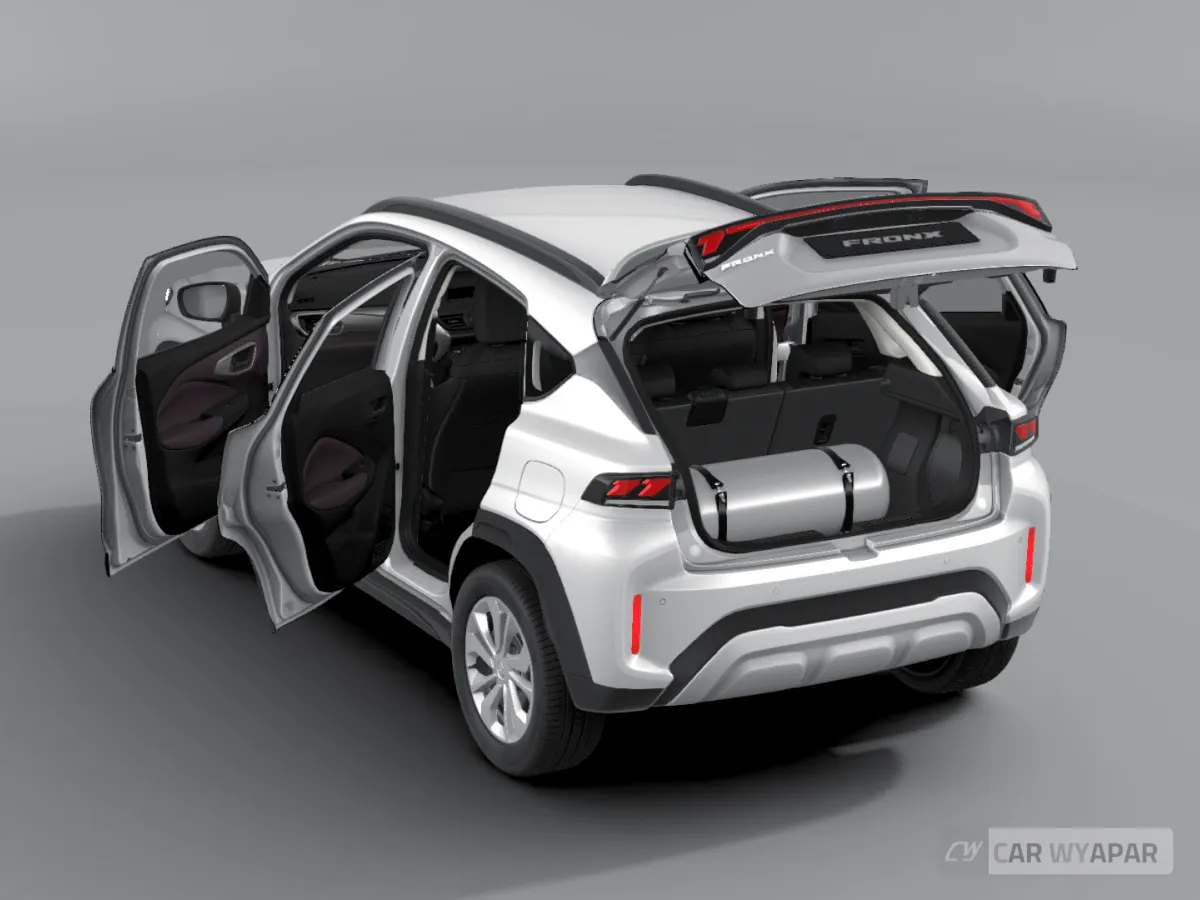
But CNG is not automatically cheaper for every buyer.
The initial purchase price is higher, boot space is affected and the financial benefit becomes stronger as annual running increases.
For someone driving 5,000 to 7,000 km a year, the petrol version can still make more sense.
For a person doing 15,000 to 20,000 km every year, the CNG version deserves a closer calculation.
The Fronx Has One More Ownership Advantage
There is another factor that is difficult to put into a spreadsheet.
Service availability.
Maruti has a large authorised service network, and its service portal allows owners to locate workshops and estimate periodic service costs.
That matters when you live outside a major metro.
A car can have cheap parts on paper, but if the nearest competent workshop is 80 km away, the spreadsheet has missed the point.
The Fronx benefits from Maruti's existing ecosystem.
So, Is the Fronx Cheap to Own?
The answer depends on what you include.
If you look only at fuel and scheduled service, the answer is straightforward.
At 30,000 km over three years, our assumptions put the cost at roughly ₹1.54 lakh, or around ₹5.1 per km.
Once depreciation is included, the number moves to roughly ₹15 per km, before insurance and other ownership costs.
That is a much more useful number for a buyer.
Because a car that gives you 22 km/l but loses a huge amount of value every year is not necessarily cheap to own.
The Fronx gets help from both sides.
It has relatively low routine running costs, and current used-car research suggests it retains value reasonably well for a young sub-compact SUV, although exact three-year resale values will depend heavily on variant, kilometres, condition, city and market demand.
/Alto VXI Plus 6.webp)