

















Is E10 Coming Back? The E20 Controversy Explained
By Nitesh Yadav • Published on 19 Aug 2026On April 1, 2026, E20 became the only petrol available at fuel stations across India. The government had achieved its 20% ethanol-blending target five...
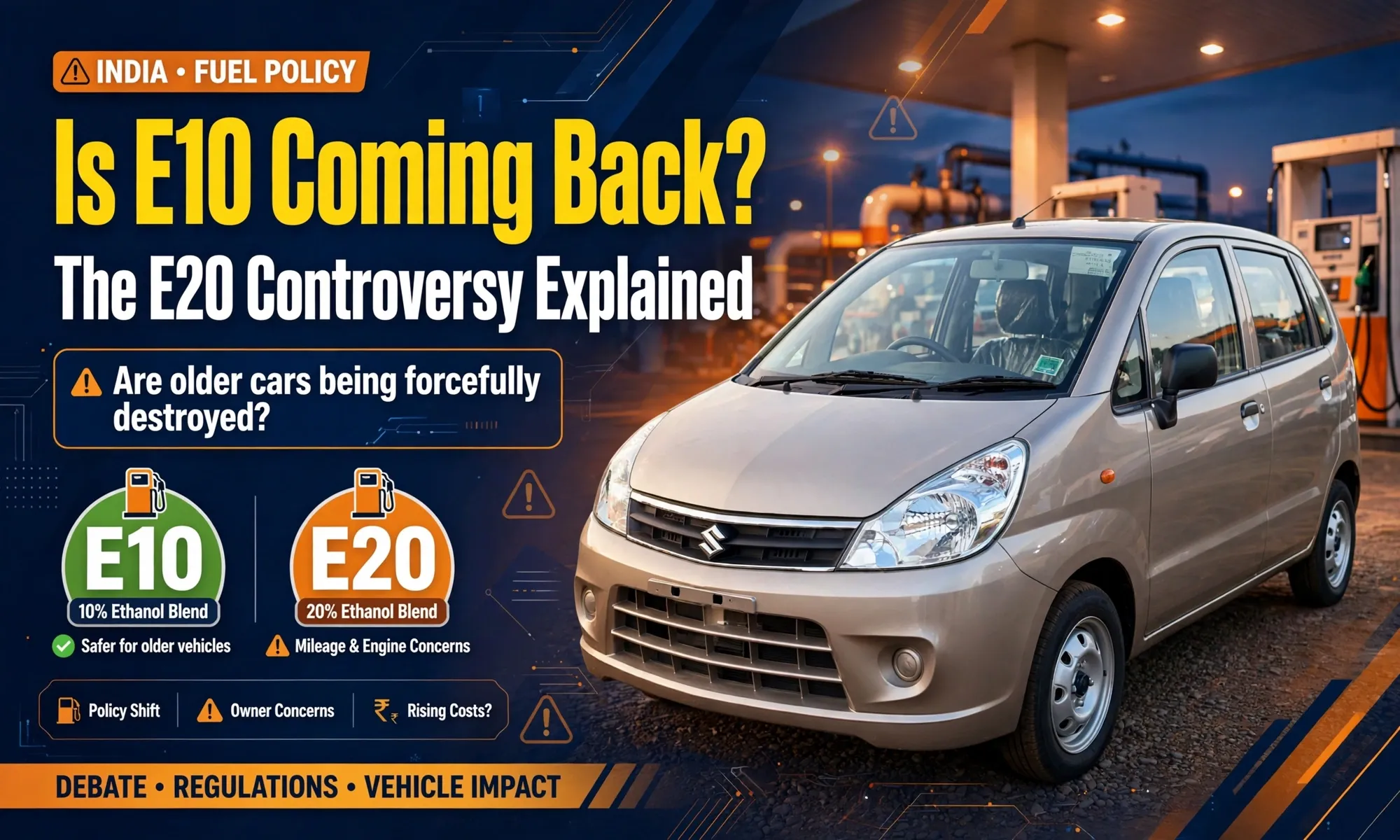
On April 1, 2026, E20 became the only petrol available at fuel stations across India. The government had achieved its 20% ethanol-blending target five years ahead of schedule. The message was clear: India was moving forward, not backward.
.webp)
Yet within months, a question that seemed settled has resurfaced with surprising force: Is E10 coming back?
The short answer is: possibly, but not yet. Here's what's actually happening.
What the Chief Economic Adviser Said
On August 17, 2026, India's Chief Economic Adviser V. Anantha Nageswaran—one of the government's top economic officials—published an opinion piece calling for E10 to be brought back alongside E20.
His reasoning was straightforward. India has roughly 75 to 80 million older two-wheelers that were built for E10, not E20. Many of these use carburettors that cannot automatically adjust for higher ethanol blends, potentially causing engines to run hotter. Older rubber seals and components not rated for higher ethanol concentrations may also deteriorate over time.
Nageswaran and his co-author Akash Poojari, a consultant with the Department of Economic Affairs, argued that restoring E10 alongside E20 would "calm most public concern" while giving owners of older vehicles a practical option until retrofitting programmes catch up.
Crucially, they clarified that their views were personal, not official government policy. But when a Chief Economic Adviser publicly contradicts the government's stated position, it signals that the debate is far from over.
The Government's Position: A Shift in Tone
Just weeks before Nageswaran's intervention, the petroleum ministry had told Parliament in no uncertain terms that there was "no proposal to revert to E0/E10 petrol". The government argued that offering multiple grades of fuel across India's 1 lakh+ fuel outlets would create an "enormous logistical challenge", raising costs and reducing efficiency. Retailing E10 and E20 simultaneously would require a complex, parallel supply chain stretching from refineries to pumps—something the current network is not equipped for.
But here's where it gets interesting. On August 19, 2026—just two days after Nageswaran's article—reports emerged that the government had quietly begun "preliminary" and "exploratory" discussions on whether E10 could be reintroduced as an option for older vehicles.
According to The Indian Express, these talks are covering both technical and non-technical aspects of the fuel supply chain. No decisions have been reached. But the very fact that discussions are happening marks a significant shift from the government's previous hardline stance.
The government has not formally changed its policy. As of now, E20 remains the only petrol available at pumps, and no timeline has been set for E10's potential return.
.webp)
Why People Are Asking: The Real-World Impact
The reason this debate has gained such traction is simple: millions of Indians are feeling the effects of E20 in their daily lives.
The Mileage Question
The government itself has acknowledged that E20's lower calorific value can reduce mileage by 3-5% in older vehicles designed for E10. Some studies suggest the energy penalty could be as high as 6-7%. Industry body SIAM has estimated the mileage drop at 2% to 6%, depending on vehicle category and age.
For a two-wheeler owner already struggling with fuel costs, that's a noticeable hit.
The Contamination Scare
In August 2026, Reuters reported that top automakers—Maruti Suzuki, Tata Motors, and Mahindra—had privately shared concerns about elevated chloride and moisture contamination in E20 fuel samples. The Society of Indian Automobile Manufacturers (SIAM) sent a complaint to the government but later withdrew it.
The oil marketing companies pushed back, saying extensive testing found "no cause for any alarm". But the episode eroded public trust.
The Political Dimension
Opposition leaders have seized on the issue. Samajwadi Party chief Akhilesh Yadav asked on X: "Who is right? The government or the adviser?" Congress MP Randeep Singh Surjewala accused the government of "imposing" E20 despite its own adviser exposing its flaws.
What Happens Next?
The situation is fluid. Here's what to watch for:
The Logistical Hurdle. Bringing back E10 is not simple. Petrol pumps have limited underground storage. Managing two grades of fuel would require significant infrastructure investment. Who bears that cost?
The Political Calculus. With opposition parties attacking the government over E20, there may be pressure to offer a compromise—especially with millions of two-wheeler owners as a voting bloc.
The Industry Position. Automakers have publicly backed E20 while privately expressing concerns. Their stance will influence the outcome.
The Environmental Argument. The government has invested heavily in the ethanol programme, citing benefits including foreign-exchange savings of nearly ₹1.90 lakh crore and reduced carbon emissions. Reversing course on E20 would be politically and economically difficult.