

























Is a New Car Making Suspension Noise Normal? Causes, Tests and What to Do
By Gaurav Cyril • Published on 8 Aug 2026A new car is supposed to make you question your EMI, not your suspension. Yet you drive your brand-new car over the first speed breaker and hear a “t...
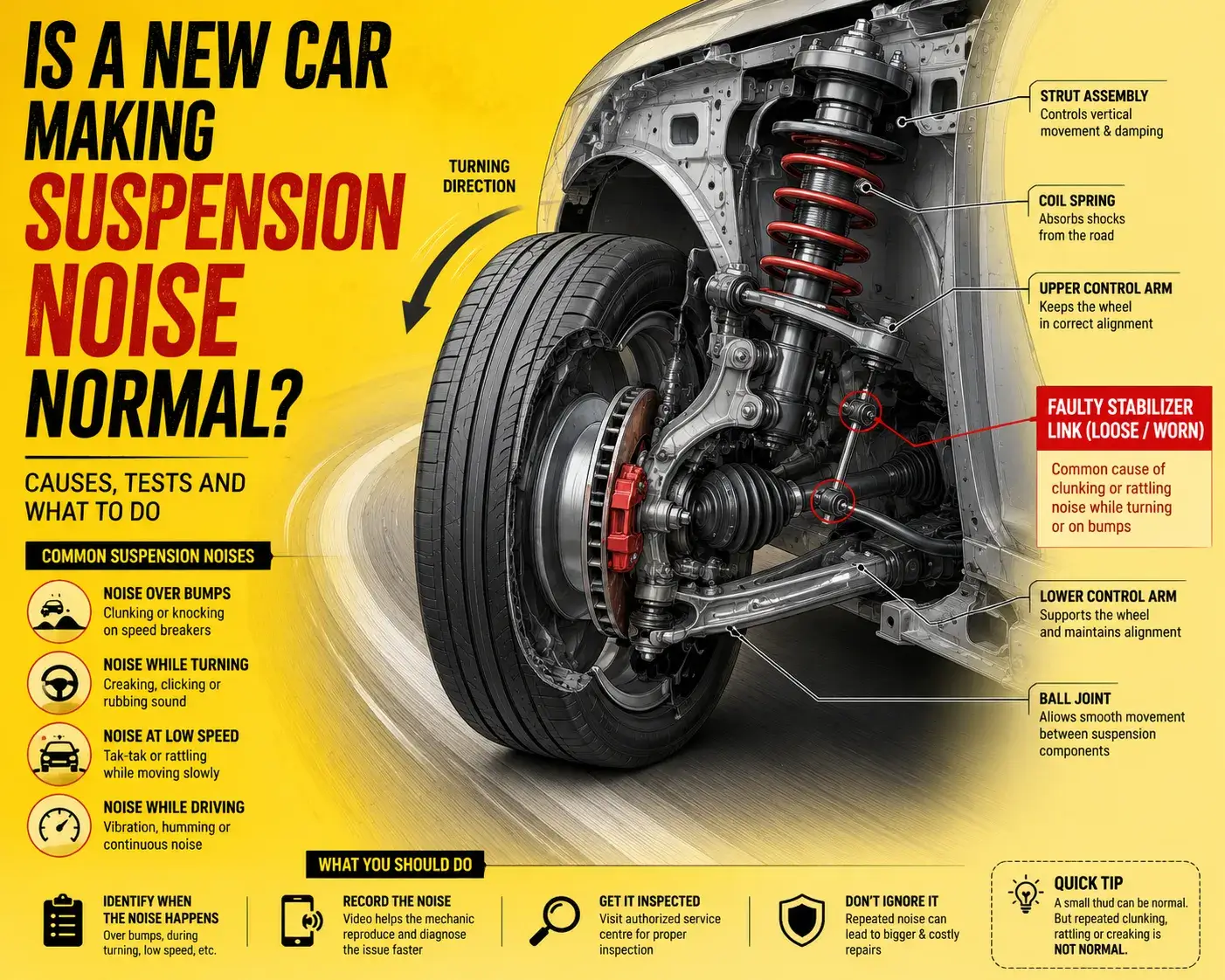
A new car is supposed to make you question your EMI, not your suspension.
Yet you drive your brand-new car over the first speed breaker and hear a “tak”, “clunk” or “khad-khad” from underneath. Suddenly, that shiny new car starts feeling like it has already completed 1 lakh km.
So, is suspension noise from a new car normal?
Sometimes, yes. A mild sound can come from normal suspension movement, tyres, loose items or the road surface. But a repeated car suspension noise, especially over bumps or while turning, should not be dismissed simply because the car is new.
A new car can also have a loose suspension component, incorrect torque, a manufacturing defect or an installation issue. New does not mean mechanically immortal.
In this guide, we explain the common causes of car suspension noise over bumps, car suspension noise when turning, car suspension noise at low speed and car suspension noise while driving, along with simple tests you can perform before visiting the service centre.
Is suspension noise in a new car normal?
A small amount of suspension noise can be normal, but a repeated or loud noise should be inspected.
The suspension system contains several moving parts, including:
Shock absorbers
Struts
Springs
Control arms
Bushes
Ball joints
Stabiliser links
Tie rods
Wheel bearings
Top mounts
Steering components
These parts move whenever the car goes over a bump, turns, brakes or accelerates.
A soft thud over a large pothole can be normal, particularly on a stiffly tuned suspension.
A sharp clunk, repeated knocking, metallic rattle or grinding noise deserves more attention.
Quick rule
|
Noise |
Possible concern |
|---|---|
|
Soft thud over large bump |
May be normal |
|
Single light knock |
Could be road or suspension movement |
|
Repeated clunk over bumps |
Needs inspection |
|
Metallic knocking |
Possible loose or worn component |
|
Creaking while turning |
Bush, mount or steering component |
|
Grinding noise |
Needs prompt inspection |
|
Clicking while turning |
Could be CV joint or related component |
|
Noise with steering vibration |
Should be inspected |
The exact cause cannot be confirmed from sound alone.
Why is my new car making suspension noise?
There are several possible reasons.
1. The suspension is naturally making noise
Suspension components move under load.
When the wheel moves upward over a bump, the spring compresses and the shock absorber moves through its travel.
Some cars produce a small amount of mechanical noise during this movement.
This is more noticeable in cars with:
Stiff suspension
Large wheels
Low-profile tyres
Heavy-duty suspension tuning
High tyre pressures
If the sound is very mild and only happens on particularly rough roads, it may not indicate a defect.
2. A loose suspension component
This is one of the things that should be checked on a new car.
A suspension component may not be properly tightened during assembly or repair.
For example:
Stabiliser link
Control arm bolt
Strut mounting bolt
Shock absorber mounting
Suspension bracket
A loose component can produce a clunking or knocking sound, particularly when the wheel moves quickly over a bump.
This is one reason you should not accept "new cars make some noise" as a complete diagnosis from a workshop.
Car suspension noise over bumps
This is one of the most common suspension complaints.
If your car makes a knocking, clunking or rattling noise over speed breakers and potholes, several components could be responsible.
Possible causes
|
Noise over bumps |
Possible cause |
|---|---|
|
Single clunk |
Loose mounting or suspension component |
|
Repeated knocking |
Stabiliser link or bush |
|
Metallic rattle |
Loose hardware or shield |
|
Creaking |
Bush or spring contact |
|
Heavy thud |
Shock absorber or suspension travel |
|
Noise from one wheel |
Localised suspension issue |
A useful clue is whether the noise occurs over every bump or only on particularly sharp bumps.
If the noise happens repeatedly on ordinary speed breakers, have the car inspected.
Car suspension noise when turning
A car making noise while turning does not automatically mean the suspension is faulty.
The steering and suspension systems work together, so several components can create similar sounds.
Possible causes include:
Strut top mount
Ball joint
Control arm bush
Stabiliser components
CV joint
Steering linkage
Wheel bearing
Clicking while making a tight turn
A repeated clicking sound while making a tight turn, particularly under acceleration, can point towards a CV joint issue.
Creaking while steering
A creaking or rubbing sound may come from a suspension mount, bush or spring-related component.
Grinding while turning
Grinding should not be ignored.
It could involve the wheel bearing, brake system or another rotating component.
Get it inspected instead of waiting for the noise to become louder.
Car suspension noise at low speed
Suspension noises can become easier to hear at low speed because there is less road and engine noise around you.
You may hear:
"tak... tak... tak"
while slowly crossing a speed breaker.
At low speed, listen for whether the sound occurs:
When the front wheels climb the bump
When the wheels come down
When only one wheel crosses the bump
While turning the steering
While braking
This information can help the mechanic identify the problem faster.
Car suspension noise while driving
If you hear suspension noise while driving on a normal road, first identify whether the sound changes with:
Speed
Steering angle
Braking
Acceleration
Road surface
A noise that increases with vehicle speed may not actually be suspension-related.
It could come from:
Tyres
Wheel bearing
Brakes
Underbody panels
Exhaust components
Wheel arch liners
This distinction is important.
Otherwise, you could arrive at the workshop complaining about the suspension and leave with a new bill for a part that was never the problem.
Car suspension noise test: How to check it yourself
You can perform a basic test before visiting the service centre.
Do not crawl underneath the car or try to loosen suspension components yourself.
Test 1: Drive over a speed breaker
Drive slowly over a familiar speed breaker.
Keep the windows open.
Listen carefully.
Now repeat the test with the wheels straight.
Then repeat it while approaching at a slightly different angle, where safe.
If the noise consistently appears from one side, tell the technician.
Test 2: Try different road surfaces
Drive slowly over:
Speed breakers
Small potholes
Uneven roads
Smooth roads
If the noise only occurs on sharp bumps, tell the mechanic exactly that.
Test 3: Steering test
In a safe, open area, slowly turn the steering left and right.
Listen for:
Clicking
Creaking
Grinding
Knocking
Do not perform aggressive steering manoeuvres just to reproduce a noise.
Your suspension does not need an audition for a rally team.
Car suspension noise speed breaker test
A speed breaker can help reproduce a suspension noise because both front wheels move through suspension travel.
Try to identify when the noise happens.
Noise while going up
This can point towards components moving under compression.
Noise at the top
This may indicate a component reaching a particular position or suspension load.
Noise while coming down
This can point towards suspension rebound or movement in a mounting/component.
The test does not identify the exact faulty part, but it gives the technician useful information.
Car suspension noise diagnosis
A proper car suspension noise diagnosis should involve a physical inspection.
The technician may check:
Suspension mounting bolts
Shock absorbers
Springs
Control arm bushes
Ball joints
Stabiliser links
Steering components
Wheel bearings
Tyres
Brakes
Underbody components
A road test is also important.
Suspension noises can be difficult to reproduce when the vehicle is stationary.
Can a new car have a faulty suspension component?
Yes.
A new car can have a defective component.
Possible reasons include:
Manufacturing defect
Assembly error
Incorrect tightening
Damaged component
Transportation damage
Incorrect wheel alignment
Foreign object or loose underbody component
The probability may be lower than in an older car, but it is not zero.
That is why warranty exists.
Should you take a new car back to the dealer for suspension noise?
Yes, if the noise is repeated, loud or unusual.
If the car is under warranty, report the issue to the authorised service centre.
Do not wait for months hoping the sound will disappear.
When visiting the workshop, avoid saying only:
Give them useful information.
For example:
That is much easier to diagnose.
Record the suspension noise
If the noise happens randomly, record it on your phone.
Try to capture:
The road
Vehicle speed
Steering position
The sound
Whether the noise occurs while entering or leaving the bump
A video can save you from the classic service-centre experience:
Customer: "Sir, awaaz aa rahi hai."
Technician: "Abhi toh nahi aa rahi."
Customer: "But it comes while driving."
Technician: "Drive karte rahiye."
And suddenly the noise develops stage fright.
When is suspension noise dangerous?
Get the vehicle checked promptly if suspension noise is accompanied by:
Steering vibration
Vehicle pulling to one side
Excessive bouncing
Uneven tyre wear
Steering becoming heavy
Grinding noise
Visible fluid leakage from a shock absorber
Loose steering
Severe knocking
Changes in braking behaviour
Wheel wobble
If the steering or wheel feels unstable, avoid driving the vehicle unnecessarily.
How to fix car suspension noise
The repair depends completely on the source.
|
Problem |
Typical solution |
|---|---|
|
Loose suspension bolt |
Correct tightening |
|
Damaged bush |
Bush replacement |
|
Faulty stabiliser link |
Link replacement |
|
Damaged shock absorber |
Shock absorber replacement |
|
Faulty top mount |
Mount replacement |
|
Ball joint issue |
Joint/control arm repair |
|
CV joint problem |
Joint/shaft repair |
|
Loose underbody part |
Secure or replace component |
|
Wheel bearing issue |
Bearing replacement |
Do not replace the entire suspension simply because the car makes a noise.
Diagnose first, replace second.
Does suspension noise mean the car is defective?
Not necessarily.
A noise does not automatically mean the car has a major manufacturing defect.
The important factors are:
Type of noise
Frequency
Location
Driving condition
Whether the noise is getting worse
Whether there are other symptoms
A mild suspension thud over a large pothole can be normal.
A repeated metallic clunk over every speed breaker in a brand-new car deserves an inspection.
New car suspension noise: What should you do?
If your new car develops a suspension noise, follow these steps:
1. Identify the condition
Note whether it happens over bumps, while turning, braking or driving straight.
2. Record the sound
Use your phone if possible.
3. Check simple things
Make sure there are no loose tools, spare-wheel components or objects in the boot creating the noise.
4. Visit the authorised service centre
Especially if the car is under warranty.
5. Ask for a road test
The technician should try to reproduce the noise.
6. Ask for the diagnosis in writing
This creates a useful service record if the problem continues.