




























How Much Will Tata Tiago EV Cost You in 5 Years? Financials Explained.
By Gaurav Cyril • Published on 18 Aug 2026The Tata Tiago EV can cost roughly Rs 9.5 lakh to Rs 12 lakh to own for five years, depending on the variant, driving distance, insurance and charging...

The Tata Tiago EV can cost roughly Rs 9.5 lakh to Rs 12 lakh to own for five years, depending on the variant, driving distance, insurance and charging cost. For a typical 1,000 km monthly user, electricity can cost around Rs 65,000 to Rs 75,000 over five years. Battery degradation will reduce driving range over time, but it does not mean the battery suddenly becomes useless. Tata's battery warranty also provides protection against excessive degradation during the applicable warranty period.
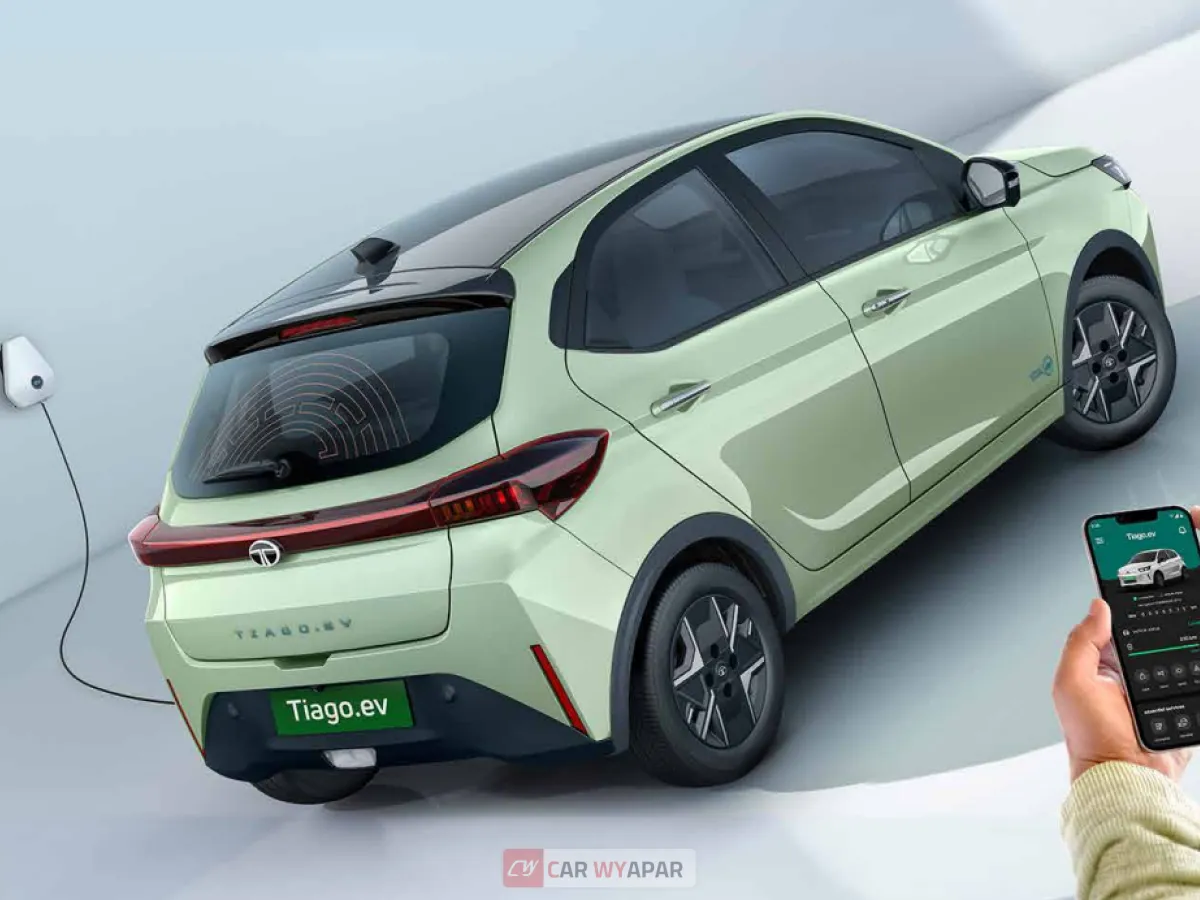
That makes the battery the biggest question for a long-term Tiago EV buyer. How much range will you lose after five years? Will Tata replace the battery if it becomes weak? And most importantly, will a five-year-old Tiago EV still make financial sense?
Tata Tiago EV 5-year ownership cost
Let us assume you drive 1,000 km every month, or approximately 60,000 km in five years. For electricity, we will use an average cost of Rs 8 per kWh. Your actual figure can be higher or lower depending on your home electricity tariff and charging losses.
|
Cost over 5 years |
Tiago EV 19.2 kWh |
Tiago EV 24 kWh |
|---|---|---|
|
Approx. ex-showroom price |
Rs 6.99 lakh |
Rs 9.49 lakh |
|
Electricity |
Rs 65,000 to Rs 70,000 |
Rs 70,000 to Rs 75,000 |
|
Servicing and consumables |
Rs 20,000 |
Rs 20,000 |
|
Insurance, approximate |
Rs 1.4 lakh |
Rs 1.7 lakh |
|
Approx. 5-year outgo |
Rs 9.5 lakh |
Rs 11.9 lakh |
These figures are estimates, not a guaranteed five-year bill. Insurance can vary significantly, while electricity cost depends on where and how you charge the car.
The interesting part is the energy bill.
How much can Tiago EV save on fuel?
Assume the Tiago EV uses around 7 km per kWh in real-world mixed driving.
Over 60,000 km, it would need roughly 8,600 kWh of electricity. At Rs 8 per unit, that works out to about Rs 69,000.
Now compare that with a petrol hatchback returning 18 kmpl.
The petrol car would need around 3,333 litres for 60,000 km. At Rs 100 per litre, fuel would cost approximately Rs 3.33 lakh.
That creates a potential energy saving of around Rs 2.6 lakh over five years.
Your actual saving will depend on your petrol price, mileage and electricity tariff, but the basic advantage remains clear. The more you drive, the more important the Tiago EV's low running cost becomes.
What happens when the Tiago EV battery degrades?
Battery degradation is normal in an electric car.
A lithium-ion battery slowly loses some of its ability to store energy as it ages. The important point is that battery degradation usually means reduced range, not sudden battery failure.
For example, consider the 24 kWh Tiago EV.
If the battery loses 10% of its original capacity, its effective capacity would be around 21.6 kWh.
If we use the claimed 285 km range as a simple reference:
|
Battery degradation |
Approx. remaining capacity |
Theoretical range |
|
0% |
100% |
285 km |
|
10% |
90% |
257 km |
|
20% |
80% |
228 km |
|
30% |
70% |
200 km |
These are only illustrative calculations. Actual range depends on speed, temperature, traffic, air-conditioning, tyre pressure and driving style.
So, if your five-year-old Tiago EV has lost 15% battery capacity, you do not suddenly need a new battery. You simply need to charge it more often.
Will Tata replace a degraded battery?
This is where the warranty becomes important.
Tata's EV warranty conditions provide protection against excessive battery degradation during the applicable warranty period. Tata states that if the high-voltage battery's State of Health falls below the specified 70% threshold, the company will repair or replace the battery to restore its capacity as required under the warranty terms.
However, normal degradation above the warranty threshold is not the same as a battery failure.
So, if your battery is at 82% health after several years, you should not expect Tata to install a brand-new battery free of cost simply because the range has fallen.
What if the battery reaches 70%?
A battery at 70% health is still usable.
It would simply offer considerably less range than when new. Using the 285 km claimed figure as a simple example, 70% capacity would work out to roughly 200 km.
For a city user who drives 30 to 50 km a day, that may still be perfectly usable.
For someone who regularly drives 200 km between charges, the same battery condition could become annoying very quickly.
This is why battery degradation has to be judged against your driving pattern, not only a percentage.
Should you worry about battery replacement after five years?
Not necessarily.
The biggest mistake is to assume that every EV needs a complete battery replacement after five years. There is no fixed five-year expiry date for the Tiago EV battery.
The battery could remain useful for many more years, although its capacity will gradually reduce.
The bigger financial question is what happens after the warranty period if the battery develops a serious fault. A complete high-voltage battery replacement can be expensive, and Tata does not publish a fixed future retail replacement price that should be inserted into today's five-year ownership calculation.
So, adding an imaginary Rs 2 lakh or Rs 3 lakh battery replacement bill would make the calculation look precise while actually being guesswork.
Is Tata Tiago EV worth keeping for five years?
For a high-mileage city user, the answer can be yes.

The 19.2 kWh version makes more sense for buyers who mainly drive inside the city, have home charging and want to keep the purchase price low.
The 24 kWh version makes more sense for buyers who want more range and plan to keep the car for many years. The larger battery also gives you more room to absorb future degradation.
If you drive only 300 to 500 km a month, the fuel savings may take much longer to justify the EV's higher purchase price.
If you drive 1,000 to 1,500 km every month, the equation becomes much stronger.