


















How Citroën Got India Wrong
By Zeeshan A Aqudus • Published on 13 Jul 2026After home, car is the next big and emotional investment in India. It is treated as an extended family member and when you try to sell a car to Indian...
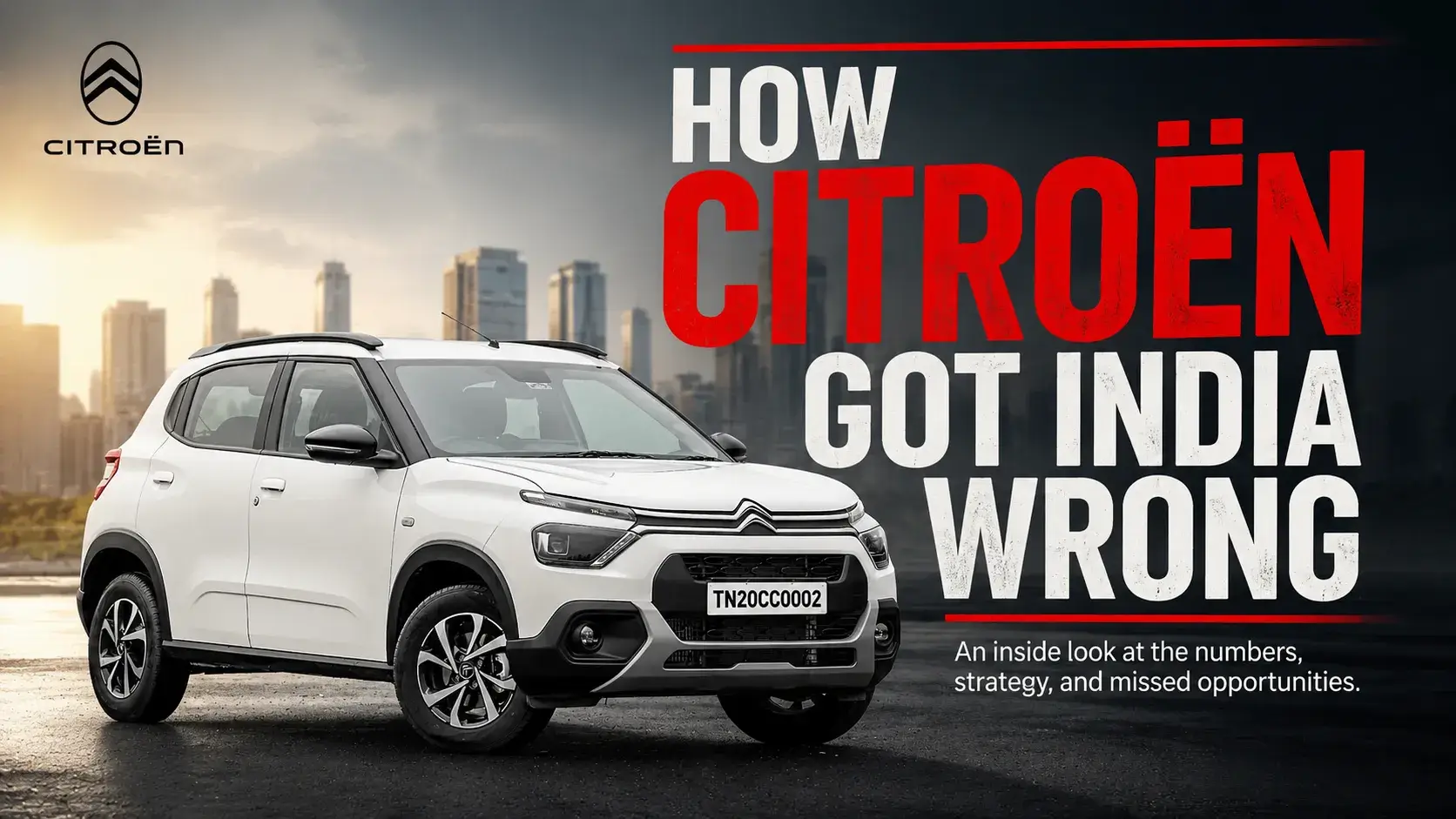
After home, car is the next big and emotional investment in India. It is treated as an extended family member and when you try to sell a car to Indians, you are expected to meet the right expectations out of an Indian middle class, if you are making budget cars.
Prior to Hyundai's entry in India in the late '90s with the Santro, the Maruti 800 ruled the market with the perfect emotion of upgrading a scooter owner and their family of "hum do hamare do" into a car. However, the Santro arrived with an aspirational side to owning a middle-class car, essentially presenting a fairly premium hatchback for Indian cities. It was Korean, yet it firmly established its place in the Indian market. Although later models like the Getz and Accent struggled, the i10 and i20 later compensated massively, and the success of the Creta requires no explanation.
Like Stellantis (Citroën's parent company), Hyundai was also a foreign brand, but it explicitly made cars for India. It perfectly balanced the product with competitive pricing, the right features, regulatory norms, and changing trends while aggressively working on its distribution network and spare parts availability.
Citroën officially entered the Indian market in April 2021 with the launch of the C5 Aircross, meaning the brand has been here for a little over 5 years.
To put that timeline into perspective, when Hyundai reached its 5-year mark in India around 2003, it had already established itself as the second-largest carmaker in the country. By then, Hyundai was selling over 100,000 cars annually, had localized its production heavily with a massive manufacturing plant in Chennai, and had built a deeply penetrated sales and service network across Indian cities and this is a stark contrast to Citroën's current niche presence and modest volumes after the same period.
Even new entrants like VinFast, a Vietnamese EV company, are arriving in India with a highly calculated, aggressive strategy. Instead of taking a slow retail approach, VinFast is focusing heavily on "taxifying" its brand footprint. They are introducing their own all-electric ride-hailing platform, Green SM, into major Indian metros like Delhi-NCR. By putting thousands of their electric cars directly onto urban roads as fleet vehicles, they ensure immediate brand visibility. More importantly, it directly builds trust with the notoriously skeptical Indian buyer. Before a retail customer ever steps foot into a showroom, they get to experience a VinFast vehicle’s cabin comfort, air conditioning performance, and daily reliability as a passenger, effectively dismantling any initial hesitation about an unfamiliar foreign brand. To back this up, VinFast is pairing its fleet strategy with after-sales service partnerships, expanding its network rapidly alongside massive warranties to reassure buyers of long-term support.
Some critics might argue that Citroën’s failure is simply down to the "timing" of entering a hyper-competitive Indian market, but that argument is completely baseless. Citroën's own sister company, Peugeot, has tried and retreated from India twice. Furthermore, their partner brand Jeep continues to struggle heavily with low sales volumes, while Fiat completely vanished from the market after discontinuing popular legacy models like the Punto and the Linea. This group clearly has a long history with India.
Why stellantis brands Struggle in India
The real reason these Stellantis brands are unable to penetrate the Indian market comes down to a fundamental disconnect with the Indian consumer's mindset. They routinely treat India as a secondary market, bringing in products that are either overly stripped of basic features in the name of "cost-cutting" (like Citroën’s initial lack of basic creature comforts in a budget segment) or mispricing vehicles so heavily that they lose all value proposition. They repeatedly fail to localize effectively, struggle to build a dense, affordable spare parts distribution network, and fail to adapt to the rapid, feature-hungry evolutionary trends of the Indian middle class. Ultimately, they try to sell global philosophies to a market that demands deeply tailor-made Indian solutions.
Stellantis is a massive automotive group formed through the merger of Italian, French, and American manufacturers. Its portfolio includes iconic Italian brands such as Fiat, Alfa Romeo, Lancia, Maserati, and Abarth, alongside French names like Peugeot, Citroën, and DS. The group also owns Opel and Vauxhall in Europe, while its American lineup consists of Jeep, Chrysler, Dodge, and Ram.
The story of these European brands in India goes back long before Stellantis came into existence. In the late 1990s and early 2000s, Opel and Fiat both tried to win over Indian buyers. Opel launched the Corsa, while Fiat introduced the Uno and later the Palio. The Opel Corsa quickly became an aspirational car. Its reassuring door thud, solid ride quality, and well-finished European cabin gave it a premium feel that stood out in its segment.
Fiat's connection with India stretches back even further. Long before the Uno arrived, the company had already become part of India's automotive history through its partnership with Premier Automobiles Limited (PAL). The Premier Padmini, based on the Fiat 1100 Delight, and later the Premier 118NE, derived from the Fiat 124, became familiar sights on Indian roads. The Padmini, often called simply "the Fiat," earned legendary status as Mumbai's famous black and yellow Kaali Peeli taxi. Its compact dimensions, strong metal body, and column-mounted gear lever made it a practical and dependable workhorse.
When Fiat attempted a comeback in the late 2000s, it faced a major challenge. Its dealer network was too small to support nationwide sales. To solve this, the company entered a manufacturing and retail partnership with Tata Motors, allowing Fiat cars to be sold through Tata dealerships. The arrangement worked well in the beginning and helped the Grande Punto hatchback and the Linea sedan find a respectable number of buyers.
Citroen’s struggles are different in India
From the Stellantis stable, Fiat came and went. Opel came and went. One European brand after another tried to crack the Indian market, only to fade away or slip into obscurity.
Then came Citroën in April 2021. But unlike Fiat or Opel, Citroën's biggest challenge was not losing momentum after early success. Its problems began much earlier, right from its product and market strategy.
The brand entered India with a very limited dealer and service network. Even after rolling out its ambitious "Citroën 2.0" expansion plan, its footprint remained at around 65 to 75 sales and service touchpoints for a long time. For a country as vast as India, that was nowhere near enough. A mass market car brand cannot expect buyers to travel hundreds of kilometres for routine servicing. Trust in the ownership experience is often built before the car is even purchased.
Citroën also brought its global co-creation philosophy to India, allowing customers to personalise their cars with contrasting colours, decals, accessories, and cosmetic packs. The idea has worked well for premium brands such as Rolls Royce, where exclusivity and personal expression are part of the ownership experience. However, the Indian mass market has moved in a different direction.
There was a time when buyers wanted their cars to stand out. Today, many prefer the opposite. White, silver, grey, and black continue to dominate sales because they are easier to maintain, have better resale value, and blend naturally into traffic. Many owners also avoid loud colours or flashy graphics.
As the retail network struggled to expand, Citroën looked for another way to build volume. It signed a major agreement with electric ride hailing company BluSmart to supply 4,000 units of the ë-C3. On paper, the move made sense. Fleet sales could generate immediate volumes, reduce dependence on retail demand, and introduce thousands of commuters to the brand through everyday rides.
The plan, however, did not deliver the expected results. Fleet deployment progressed slower than anticipated, and dependence on a single large customer did little to build a wider retail presence. More importantly, fleet visibility could not replace what every successful carmaker eventually needs, a strong dealership network, dependable after sales support, and the confidence of private buyers.
On the top of it, the infamous Blue Smart scandal got exposed by SEBI and the company got shut down in April 2025.
Citroen’s sales figure in India
Let’s talk about last year’s(2025) interesting sales chart first
|
Brand |
H1 2025 Sales (Jan to Jun) |
Avg. Monthly Sales |
Avg. Daily Sales |
Times More Than Citroën |
|---|---|---|---|---|
|
Maruti Suzuki |
878,705 |
146,451 |
4,820 |
362× |
|
Hyundai |
285,809 |
47,635 |
1,567 |
118× |
|
Tata Motors |
269,968 |
44,995 |
1,483 |
111× |
|
Nissan |
11,723 |
1,954 |
64 |
4.8× |
|
Citroën |
2,427 |
405 |
13 |
1× |
What the numbers reveal
Maruti sells about 4,820 cars every day, which is almost twice Citroën's entire six month sales.
Hyundai sells around 1,567 cars a day, meaning it matches Citroën's H1 volume in less than two days.
Tata sells roughly 1,483 cars daily, also reaching Citroën's six month total in under two days.
Even Nissan, another brand that has struggled in India, sells nearly five times more vehicles than Citroën, averaging about 64 cars every day.
Now let’s talk about this year’s number:
|
Model |
Jan 2026 |
Feb 2026 |
Mar 2026 |
Apr 2026 |
May 2026 |
Jun 2026 |
H1 Total |
Share of H1 Sales |
|---|---|---|---|---|---|---|---|---|
|
Citroën C3 |
831 |
753 |
531 |
392 |
110 |
248 |
2,865 |
68.7% |
|
Citroën Basalt |
70 |
73 |
62 |
43 |
95 |
214 |
557 |
13.4% |
|
Citroën ë-C3 |
24 |
23 |
13 |
32 |
60 |
99 |
251 |
6.0% |
|
Citroën Aircross |
131 |
99 |
77 |
58 |
66 |
49 |
480 |
11.5% |
|
Citroën C5 Aircross |
2 |
2 |
0 |
0 |
2 |
0 |
6 |
0.1% |
|
Total Brand Sales |
1,058 |
950 |
683 |
525 |
333 |
610 |
4,159 |
100% |
The C3 remains Citroën's backbone, contributing 2,865 units, nearly 69% of total sales in H1 2026. However, its momentum has faded sharply, with sales falling from 831 units in January to 110 in May, before recovering slightly to 248 in June.
The Basalt is the only model showing positive momentum. Although it sold just 557 units over six months, June sales reached 214 units, more than three times its January figure, indicating growing buyer interest.
The ë-C3 EV improved steadily from 24 to 99 units between January and June but remained a niche product with only 251 units sold. Meanwhile, the Aircross continued to lose ground, declining from 131 units to 49 units, while the C5 Aircross was virtually absent from the market, selling just six units during the entire period.
Overall, Citroën's monthly sales dropped from 1,058 units in January to 333 in May, a 68.5% decline. Although June recovered to 610 units, sales were still 42% lower than January, highlighting the brand's struggle to build consistent demand.
Dealer’s Dilemma across India
For any dealer principal, running a car showroom is a high-cost business driven by rotational cash flow. When monthly numbers drop to single digits per outlet, it triggers a dangerous chain reaction that completely kills investor interest in the brand.
Here is why new and existing business partners are pulling out or refusing to touch a Citroën dealership:
Unsustainable Operational Expenses (OpEx): Maintaining a prime commercial real estate space, paying sales staff, and running test-drive fleets requires high monthly overheads. When a showroom sells only 3 to 5 cars a month, the gross margins cannot even cover the basic electricity and electricity bills, let alone the interest on inventory funding.
Massive Dead Stock: Dealerships are forced to hold inventory sent by the manufacturer. With vehicles sitting in stockyards for months due to low demand, dealers face immense financial pressure from mounting interest charges on their inventory capital.
Zero Resale and Service Pull: Because the total car park (number of Citroën cars on the road) is incredibly small, the workshop—which is traditionally the most profitable side of a dealership—remains empty. Without steady service revenue, a dealership cannot survive long-term.
E20 issue: The transition to E20 petrol introduces another layer of uncertainty for every automaker operating in India. Although manufacturers have upgraded newer vehicles to be E20 compatible, the rollout has raised questions among consumers about long-term reliability, fuel economy, and maintenance costs. For manufacturers with extensive dealer networks, handling occasional fuel-related complaints is part of normal after-sales operations. A customer experiencing a fuel system issue can usually find an authorised workshop within a reasonable distance, have the vehicle diagnosed, and obtain genuine replacement parts without significant delays.
Citroën operates under very different circumstances.
Incidences of Closing Dealerships
This financial strain isn't just theoretical; it has already led to highly publicized exits across major Indian hubs:
The Delhi-NCR Exits: Prominent dealer groups in the National Capital Region quietly closed down their prime showrooms after facing massive monthly losses, consolidating their operations into smaller, shared generic service workshops or exiting the brand completely.
Tier-2 Surrenders: In several Tier-2 cities across Uttar Pradesh and Maharashtra, dealers who had signed up during the initial excitement surrendered their franchises within 18 to 24 months. Many realized that the footfalls were virtually non-existent, and the cost of maintaining a standalone corporate identity was draining their core businesses.
Pivoting to Competitors: Multiple multi-brand dealer networks that initially gave floor space to Citroën have actively converted those properties into showrooms for rapidly growing brands like Mahindra, Tata, or even newer entrants.
Citroën’s dated products
Compounding Citroën's dealership and retail challenges is the fact that it is competing with a product lineup that increasingly feels out of step with the Indian market. Over the past decade, buyer expectations have changed dramatically. Features that were once exclusive to premium luxury cars have steadily moved into the mainstream. Today, vehicles priced between ₹15 lakh and ₹25 lakh routinely offer panoramic sunroofs, ventilated seats, Level 2 ADAS, 360 degree cameras, connected car technology, dual digital displays, powered tailgates, and premium audio systems.
Indian manufacturers such as Tata Motors and Mahindra have played a major role in this shift, while Maruti Suzuki, Hyundai, Kia and MG have ensured these features are no longer niche selling points. Buyers have become accustomed to expecting more equipment for their money, making feature value almost as important as engine performance or ride quality.
Against this backdrop, Citroën's portfolio often feels under-equipped. While the company has consistently focused on ride comfort and suspension tuning, many of its models launched without features that buyers now consider essential in their respective price segments. In a market where showroom comparisons happen within minutes, missing equipment can quickly become a deciding factor.
This creates another challenge. Every model update now requires significant investment, whether through new technology, feature additions, localisation, or compliance with evolving regulations. Larger manufacturers can spread these development costs across hundreds of thousands of vehicles sold every year. For a low-volume player like Citroën, recovering those investments becomes far more difficult, putting additional pressure on profitability.