
























DPF Regeneration While Driving: Is It Normal, How It Works and What You Should Do
By Nitesh Yadav • Published on 8 Aug 2026Your diesel car does not randomly decide to burn fuel for fun. When the DPF regeneration starts, the car is basically putting its exhaust system throu...
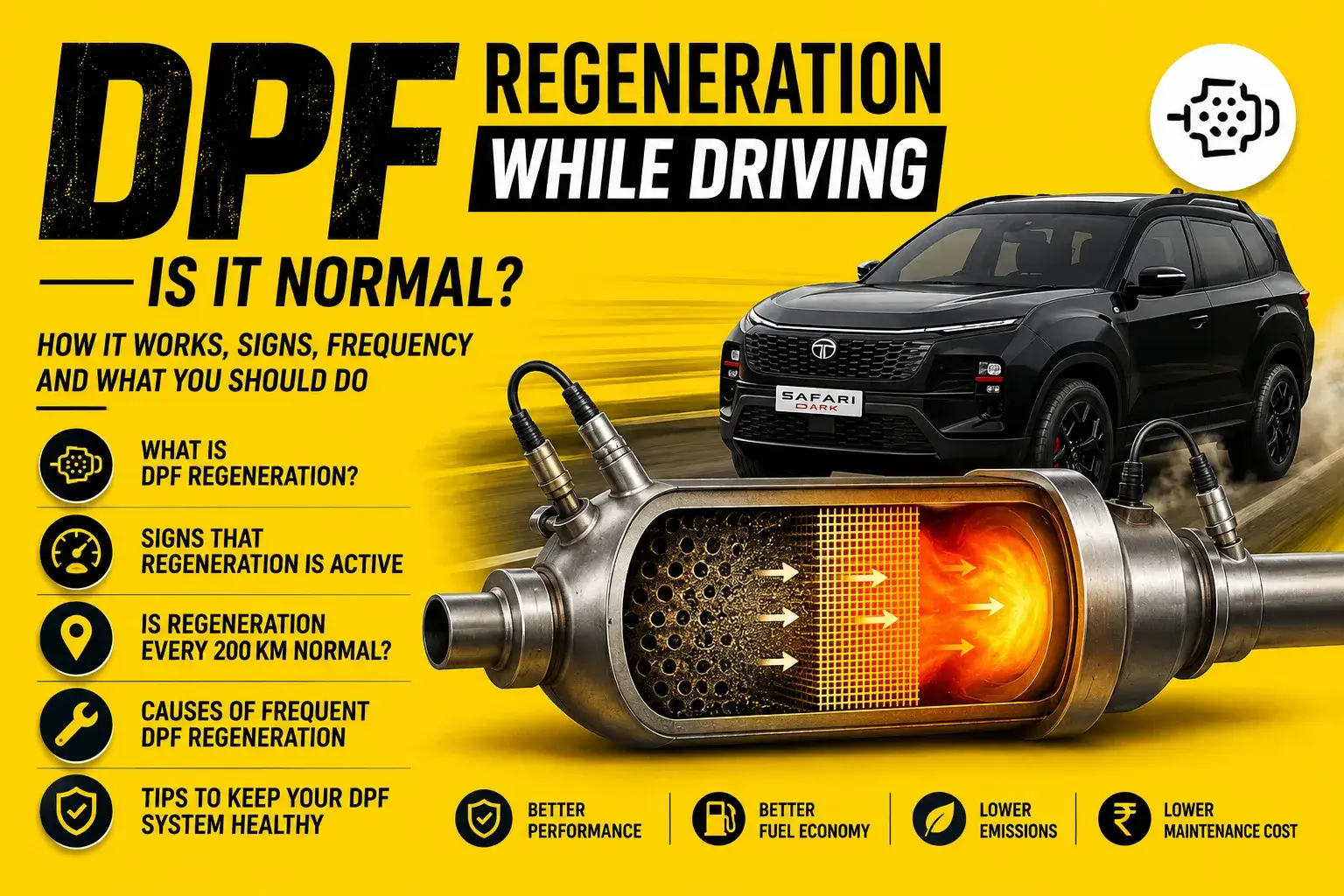
Your diesel car does not randomly decide to burn fuel for fun. When the DPF regeneration starts, the car is basically putting its exhaust system through a controlled barbecue.
If you own a modern diesel car, you may notice higher RPM, a slightly different engine sound, increased fuel consumption, hot exhaust smell, or cooling fans running after you park. These can all happen during DPF regeneration while driving.
But there is one important question: How often should DPF regeneration happen while driving?
A regeneration every few hundred kilometres can be normal. However, if your car is regenerating unusually often, taking too long to complete the process, or repeatedly showing a DPF warning, something may be wrong.
Let's understand what is happening under the bonnet.
What is DPF regeneration?
DPF stands for Diesel Particulate Filter. It is fitted to modern diesel engines to trap soot particles from the exhaust gases.
As you drive, soot slowly builds up inside the DPF. The engine management system monitors the filter using sensors and estimates how much soot has accumulated.
When the soot level reaches a certain point, the car starts DPF regeneration while driving.
During regeneration, the exhaust temperature is raised high enough to burn the accumulated soot and turn much of it into ash and gases.
In simple terms:
Diesel engine → soot gets trapped → soot builds up → exhaust temperature rises → soot burns → DPF gets cleaned
The process is automatic in most modern diesel cars.
Can DPF regeneration happen while driving?
Yes. In fact, DPF regeneration while driving is one of the most common ways modern diesel cars clean the filter.
This is usually called active regeneration.
The ECU changes engine operation to increase exhaust temperature. Depending on the vehicle, this can involve additional fuel injection, changes in injection timing, EGR operation and other engine-management adjustments.
The driver normally does not need to press a button.
You simply continue driving.
However, the car needs suitable conditions to complete the regeneration.
What happens during DPF regeneration while driving?
You may notice some unusual behaviour when regeneration starts.
Common signs include:
|
Sign |
What it means |
|---|---|
|
Higher engine RPM |
ECU may increase engine speed to generate heat |
|
Slightly higher fuel consumption |
Extra fuel may be used during regeneration |
|
Cooling fan running |
Exhaust and engine bay temperatures can become high |
|
Hot smell from exhaust |
Soot is being burned at high temperature |
|
Different engine sound |
Engine operation may change slightly |
|
Start-stop may stop working |
System may temporarily disable it |
|
Higher exhaust temperature |
Required for soot combustion |
|
Idle RPM may increase |
Common during active regeneration |
None of these automatically means your engine has a problem.
Your diesel car is basically saying, "Excuse me, I need to clean my lungs."
How long does DPF regeneration take while driving?
A typical regeneration may take around 10 to 30 minutes, although the exact duration depends on the vehicle, soot load, driving conditions and engine temperature.
Some cars may complete it faster. Others may need more time.
The biggest problem is interruption.
If you repeatedly start a regeneration and then switch off the engine after a few minutes, the process may not finish.
The ECU can then attempt regeneration again later.
That is when drivers start wondering:
"Why is my diesel car regenerating every 200 km?"
Is DPF regeneration every 200 km normal?
There is no universal number that applies to every diesel car.
A regeneration interval of around 200 km can be possible under certain driving conditions. But the distance alone does not tell you whether the DPF system is healthy.
For example, a car driven mostly in heavy city traffic may regenerate more frequently than the same car driven regularly on highways.
Short trips are particularly bad for DPF systems because the exhaust may not stay hot enough for long enough.
Driving conditions matter
|
Driving pattern |
Effect on DPF |
|
Long highway drives |
Generally favourable |
|
Regular 20 to 30 km trips |
Usually better than very short trips |
|
Heavy city traffic |
Can increase regeneration frequency |
|
Repeated 5 to 10 km trips |
Poor for DPF |
|
Long idling |
Can contribute to problems |
|
Frequent stop-start driving |
Makes regeneration harder |
|
Highway driving at steady speed |
Usually helps regeneration complete |
So, DPF regeneration while driving every 200 km is not automatically a fault.
But if the regeneration interval suddenly drops from, say, several hundred kilometres to around 100 to 200 km, it deserves attention.
Why does my DPF regenerate so frequently?
Frequent regeneration can happen for several reasons.
1. Mostly city driving
This is probably the most common reason.
If you drive through traffic every day, your diesel engine may spend a lot of time at low speed and low load.
The exhaust temperature may not remain high enough for passive soot burning.
The ECU therefore has to initiate active regeneration more often.
2. Short trips
A diesel car does not particularly enjoy being used like a petrol hatchback for five-minute errands.
If your trips are very short, the engine and exhaust system may not reach the temperatures required for efficient DPF operation.
The result can be increasing soot accumulation.
3. Regeneration is being interrupted
Suppose regeneration starts.
You drive for five minutes.
You reach your destination.
You switch off the engine.
The regeneration stops.
Repeat this several times and the DPF may not get properly cleaned.
The ECU may then request another regeneration sooner.
4. Faulty DPF pressure sensor
The DPF system uses sensors to monitor pressure across the filter.
If the differential pressure sensor gives incorrect readings, the ECU may think the DPF is more clogged than it actually is.
That can trigger unnecessary regeneration.
5. EGR problems
A faulty or heavily carbonised EGR system can affect combustion and increase soot production.
More soot means the DPF fills faster.
And when the DPF fills faster, regeneration happens more frequently.
It's a beautiful little cycle of mechanical misery.
6. Dirty or faulty injectors
Poor injector performance can affect combustion and increase particulate production.
In some cases, excessive fuelling can contribute to high soot production.
7. Engine oil entering the combustion system
Worn engine components, turbocharger problems or other mechanical issues can allow oil to enter the combustion process.
This can increase exhaust contamination and create additional DPF problems.
8. DPF ash accumulation
Regeneration burns soot, but it does not remove all the non-combustible ash that accumulates in the filter over time.
As ash builds up, the usable capacity of the DPF decreases.
The filter can then require regeneration more frequently.
Is DPF regeneration while driving better than parked regeneration?
Generally, yes, if the vehicle is designed to perform automatic regeneration while driving.
During normal driving, the vehicle can control engine load, fuel injection and exhaust temperature while air flows naturally through the exhaust system.
Some vehicles also offer a manual or forced regeneration procedure.
That is different.
Do not perform a forced regeneration simply because you want to clean the DPF.
It should normally be performed according to the manufacturer's procedure and only when required.
A forced regeneration can create extremely high exhaust temperatures.
Doing it incorrectly can damage components or create a fire risk.
What should you do during DPF regeneration while driving?
The best thing is usually simple:
Keep driving if conditions are safe.
If you notice that regeneration is happening, avoid immediately stopping the engine if you can safely continue driving.
A steady drive at moderate speed and suitable engine load can help the regeneration finish.
However, don't blindly follow internet advice saying you must drive at exactly 80 km/h in a particular gear.
There is no single magic speed that works for every diesel car.
The correct operating conditions depend on the engine, ECU calibration and manufacturer's instructions.
Should you accelerate hard during DPF regeneration?
No.
You do not need to drive aggressively.
DPF regeneration is controlled by the ECU.
Hard acceleration does not magically clean the filter faster.
Instead, maintain a steady speed where possible and follow your vehicle's owner's manual.
The goal is stable operating conditions, not a Formula 1 qualifying lap.
Can you stop the car during DPF regeneration?
You can physically stop the car, but repeatedly interrupting regeneration is not a good habit.
If the regeneration is almost complete, stopping the engine may prevent the cycle from finishing.
One interruption is usually not a disaster.
Repeated interruptions can become a problem.
If your dashboard specifically tells you to continue driving, follow that instruction.
What happens if DPF regeneration keeps getting interrupted?
The soot load can continue increasing.
The ECU may then request another regeneration.
If the problem continues, the vehicle may eventually display a DPF warning.
In severe cases, the car can enter a reduced-power or limp-home mode.
At that point, "I'll take it to the mechanic next Sunday" may stop being a brilliant financial strategy.
DPF regeneration while driving vs passive regeneration
There are two important types of regeneration to understand.
Passive regeneration
Passive regeneration happens when exhaust temperatures are naturally high enough to burn accumulated soot.
It can occur during sustained highway driving or other high-load conditions.
The ECU may not need to make major changes to engine operation.
Active regeneration
Active regeneration is deliberately initiated by the engine management system.
The ECU raises exhaust temperature to burn the soot.
This is the regeneration most drivers notice.
|
Feature |
Passive regeneration |
Active regeneration |
|
Trigger |
Naturally high exhaust temperature |
ECU-controlled |
|
Driver awareness |
Often low |
More noticeable |
|
Highway driving |
Common condition |
Can also happen |
|
Fuel consumption |
Usually little additional fuel |
Can increase |
|
ECU intervention |
Lower |
Higher |
What is forced DPF regeneration?
Forced regeneration is a service procedure used when normal regeneration is not enough or cannot take place.
A diagnostic scanner is generally used to command the ECU to perform the process.
It may be required when the soot load reaches a level where normal driving regeneration is no longer possible.
However, a forced regeneration should not be treated as a universal cure.
If the underlying issue is a faulty sensor, injector, EGR system, turbocharger or another component, forcing the DPF to regenerate does not fix the real problem.
It simply gives the problem another appointment with you.
When should you worry about frequent DPF regeneration?
You should investigate the vehicle if you notice several of these symptoms together:
Regeneration happening unusually frequently
DPF warning light
Check-engine light
Significant loss of power
Excessive smoke
Very high fuel consumption
Regeneration taking unusually long
Regeneration repeatedly failing
Engine oil level increasing
Strong abnormal exhaust smell
Cooling fan running excessively
Limp mode
One symptom alone may not indicate a serious problem.
Several symptoms together deserve a proper diagnostic check.
Can frequent DPF regeneration damage the engine?
Frequent regeneration itself is not necessarily harmful because the system is designed to regenerate.
The concern is why it is happening so often.
Repeated active regeneration can increase fuel consumption. In some diesel engines, incomplete or poorly controlled regeneration can also contribute to fuel dilution of the engine oil.
That is why frequent regeneration should not simply be ignored.
If the engine oil level starts increasing, get the vehicle inspected promptly.
How to reduce DPF regeneration frequency
You cannot completely control when regeneration occurs, but you can create better conditions for the system.
Drive the car regularly on longer trips
If your diesel is used almost entirely for short city trips, occasional longer drives can help the DPF system operate properly.
Avoid unnecessary idling
Long periods of idling do not provide the same conditions as a properly loaded engine.
Don't ignore warning lights
A DPF warning is not decorative dashboard lighting.
Get the cause checked.
Use the correct engine oil
Modern diesel engines with DPF systems generally require specific low-ash engine oils.
Use the specification recommended by the manufacturer.
Using the wrong oil can increase ash accumulation and affect the emissions system.
Maintain the engine
Injector, EGR, turbocharger, air filter and sensor problems can all affect soot production and DPF behaviour.
A healthy engine makes the DPF's job easier.