





























Should You Switch to an EV Because Petrol Is Getting Expensive? CarWyapar Expert Advice
By Nitesh Yadav • Published on 30 Aug 2026Yes, you should consider switching to an EV if petrol costs are becoming a major part of your monthly driving expense, especially if you have home cha...
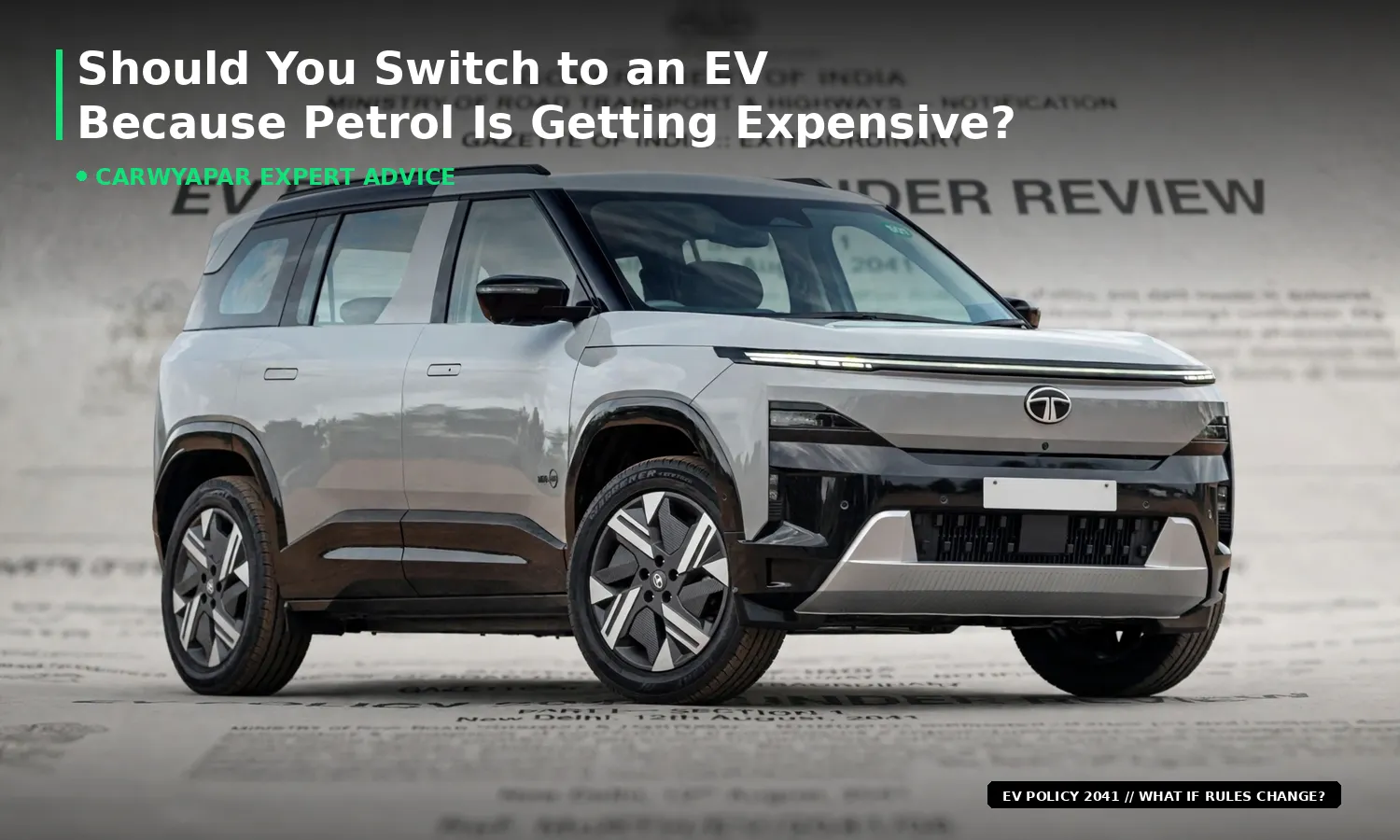
Yes, you should consider switching to an EV if petrol costs are becoming a major part of your monthly driving expense, especially if you have home charging and drive 15,000 km or more every year. But expensive petrol alone is not enough reason to buy an EV. Car buyers also need to consider electricity prices, charging costs, government policies, battery life, resale value and future vehicle rules. Over a 10 to 15 year ownership period, these factors can change the financial advantage of an EV.
And that brings us to the uncomfortable part of buying a car in India.
Your car may belong to you, but many things that decide its cost do not.
Fuel prices are influenced by taxes and government policy. Electricity prices are regulated. Vehicle registration rules can change. Emission standards become stricter. Cities can introduce restrictions. EV incentives can be added, reduced or removed.
So when someone says, "Petrol is expensive, just buy an EV," the answer is slightly more complicated.
The better question is:
Will an EV remain financially sensible if today's policies and prices change?
That is the question CarWyapar believes every serious EV buyer should ask.
Cars Live Longer Than Policies
A modern car can easily remain on the road for 10, 15 or even 20 years.
Government policies do not have that kind of patience.
Think about someone who bought an expensive Mercedes-Benz, Audi or BMW around 2010. At that time, the buyer could reasonably expect to own the car for many years.
But could that buyer have predicted that Delhi-NCR would eventually enforce restrictions around the age of petrol and diesel vehicles?
Probably not.
The National Green Tribunal introduced major restrictions around old vehicles in Delhi-NCR, with the Supreme Court later becoming involved in the matter. Petrol vehicles over 15 years and diesel vehicles over 10 years have faced restrictions in the region.
Then came another policy shift that many petrol-car buyers did not have on their radar.
E20 fuel.
When someone purchased a petrol car in 2015 or 2018, how many buyers were asking the dealer:
Very few.
The point is not that E20 is good or bad.
The point is that the fuel you put into your car can change during the car's lifetime.
And the same principle applies to EVs.
Today, charging an EV at home may be cheap.
But what happens if electricity becomes more expensive?
What happens if governments introduce special EV tariffs?
What happens if apartment societies start charging a separate fee for EV charging?
What happens if public fast charging becomes much more expensive?
Nobody knows.
And that is exactly why a 2026 EV purchase should not be calculated only using 2026 electricity prices.
The EV Adoption Story Is Really a Policy Story Too
EV adoption is often presented as a simple technology story.
Petrol engine:
Fuel goes in.
Engine burns it.
Car moves.
EV:
Electricity goes in.
Battery stores it.
Motor moves the car.
Simple.
But the economics sitting underneath these two systems are heavily connected to government policy.
For petrol cars, governments collect large amounts of revenue through fuel taxes.
For EVs, governments currently have strong reasons to encourage adoption through incentives, lower taxes in some cases and charging policies.
But imagine a future where EVs become the majority of new car sales.
The government still needs revenue to build roads, run transport systems and fund public services.
If fewer people buy petrol, the fuel-tax pool naturally becomes smaller.
That raises an obvious question:
Where does the lost revenue come from?
It could come from road taxes.
It could come from vehicle registration.
It could come from electricity.
It could come from charging infrastructure.
It could come from distance-based taxation.
Or it could come through a system we have not even thought about yet.
That does not mean the government will definitely introduce a ₹50 per unit EV charging tariff.
It means buyers should understand one basic rule:
When technology changes the source of government revenue, policy usually changes with it.
What If EV Charging Becomes ₹50 Per Unit?
Let's take the extreme scenario.
Suppose your EV consumes 0.18 kWh per kilometre.
At ₹8 per unit:
₹8 × 0.18 = ₹1.44 per km
Very attractive.
Now imagine the same EV is charged at ₹50 per unit:
₹50 × 0.18 = ₹9 per km
Suddenly, the EV's energy cost becomes higher than the assumed running cost of many efficient petrol cars.
That sounds like an EV disaster.
But there is an important detail.
Not every EV owner would necessarily pay the same electricity tariff.
Home charging, apartment charging, workplace charging, public AC charging and DC fast charging can all have different pricing structures.
Someone charging mostly at home could remain relatively protected.
Someone who depends entirely on public fast chargers could face a much bigger hit.
This is why access to charging can matter more than the headline electricity price.
The CarWyapar 20-Year EV Risk Matrix
The following table is not a prediction. It is a scenario assessment of how likely each factor is to become a meaningful issue for EV adoption somewhere in India during the next 20 years.
|
Possible Hindrance |
Probability in Next 20 Years |
Expected Hindrance Level |
Why It Matters |
|---|---|---|---|
|
Electricity prices increase |
60% |
3/5 |
Raises EV running costs |
|
Special EV electricity tariff |
35% |
3/5 |
Could reduce today's charging advantage |
|
Public charging becomes expensive |
65% |
4/5 |
Major issue for users without home charging |
|
Charging infrastructure shortage |
45% |
4/5 |
Can slow EV adoption in smaller cities |
|
Apartment charging problems |
50% |
4/5 |
Important for urban households |
|
Battery degradation |
70% |
3/5 |
Natural ageing affects range |
|
Expensive battery replacement |
35% |
4/5 |
Large repair bill after warranty |
|
EV resale value falls quickly |
60% |
3/5 |
New battery technology can hurt old EV values |
|
EV incentives are reduced |
80% |
2/5 |
Incentives cannot be assumed forever |
|
New EV taxes |
50% |
3/5 |
Governments may seek replacement revenue |
|
Petrol prices rise further |
85% |
4/5 |
Makes ICE ownership more expensive |
|
ICE restrictions increase |
80% |
5/5 |
Could make older ICE cars harder to use |
|
EV purchase prices fall |
75% |
Positive |
Makes EVs easier to buy |
|
Battery technology improves |
90% |
Positive |
Better range and lower cost |
|
Charging becomes faster |
90% |
Positive |
Reduces the biggest EV inconvenience |
|
Charging network expands |
90% |
Positive |
Makes long-distance EV use easier |
The important takeaway is that EV adoption has risks, but ICE ownership has risks too.
In fact, over a 20-year period, some of the biggest risks to EV adoption could actually be offset by even bigger risks facing petrol and diesel vehicles.
That is where the calculation gets interesting.
Sierra EV vs Sierra Petrol: The Financial Reality
Let's take the Tata Sierra as an example.
The starting price gap between the Sierra ICE and Sierra EV is significant.
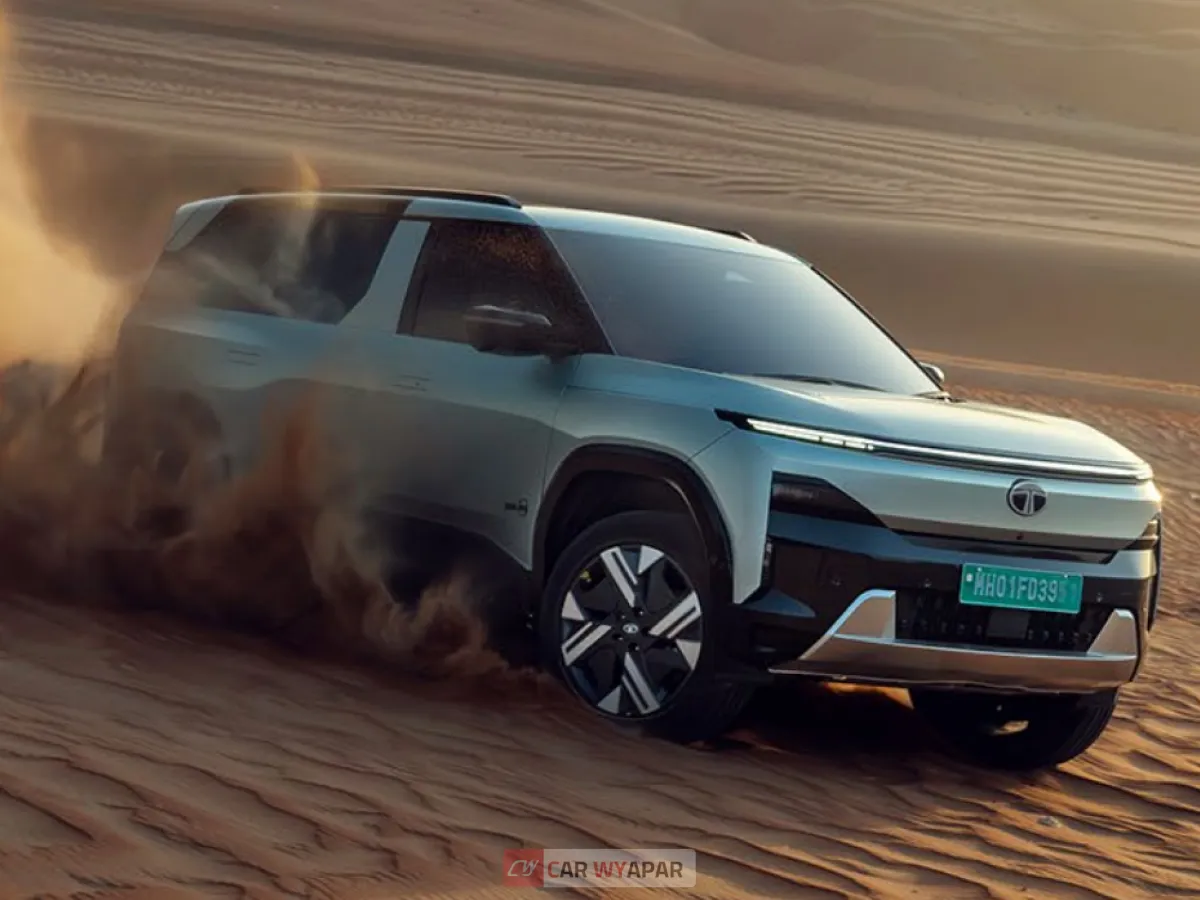
The Sierra petrol starts around ₹11.49 lakh, while the Sierra EV starts around ₹18.79 lakh ex-showroom.
That means the EV buyer pays considerably more upfront.
The question becomes:
Can lower running and maintenance costs recover that additional investment?
Using a simple 15,000 km annual usage assumption:
|
Financial Factor |
Sierra Petrol |
Sierra EV |
|---|---|---|
|
Example ex-showroom price |
₹11.49 lakh |
₹18.79 lakh |
|
Assumed energy price |
₹100/litre |
₹8/kWh |
|
Efficiency used |
17 kmpl |
0.18 kWh/km |
|
Energy cost/km |
₹5.88 |
₹1.44 |
|
Annual distance |
15,000 km |
15,000 km |
|
Annual energy cost |
₹88,235 |
₹21,600 |
|
5-year energy cost |
₹4.41 lakh |
₹1.08 lakh |
|
10-year energy cost |
₹8.82 lakh |
₹2.16 lakh |
The EV saves about ₹6.66 lakh in energy costs over 10 years under these assumptions.
But the initial price gap is around ₹7.30 lakh.
So the EV does not automatically become cheaper simply because electricity costs less than petrol.
You need to include:
Maintenance
Insurance
Financing cost
Depreciation
Battery warranty
Battery degradation
Resale value
Charging installation
Public charging expenses
That is the real ownership calculation.
So When Should You Actually Switch to an EV?
The answer is simple.
Buy an EV if:
You can charge at home.
This is probably the biggest advantage an EV owner can have.
You drive 15,000 to 20,000 km or more every year.
Higher usage gives the lower running cost more opportunity to recover the higher purchase price.
You plan to keep the car for at least 7 to 10 years.
Longer ownership allows more time for fuel savings and lower maintenance to work in your favour.
Most of your daily driving is predictable.
Office commutes, school runs, city trips and regular highway routes are ideal EV use cases.
You are comfortable with technology changing quickly.
A 2032 EV will probably be much better than a 2026 EV. That is good for the industry, but potentially bad for your resale value.
/Xuv 3xo RevX-1.webp)
 1.webp)


