



























Tata Safari Owners Beware, This Common DPF Mistake Can Cost You Big
By Nitesh Yadav • Published on 14 Apr 2026Smoke used to be a normal “diesel thing”. You press the throttle, black cloud comes out, end of story. Nobody asked questions. Then pollution levels g...
Smoke used to be a normal “diesel thing”. You press the throttle, black cloud comes out, end of story. Nobody asked questions. Then pollution levels got serious, cities started choking, and rules had to change.
Older diesel cars did not have a DPF. The big shift came when BS6 emission norms were introduced in India. These rules forced car makers to reduce harmful particles from exhaust. That is where the Diesel Particulate Filter, DPF, became compulsory. Modern diesel SUVs like the Tata Safari now use this system to trap soot before it goes into the air.
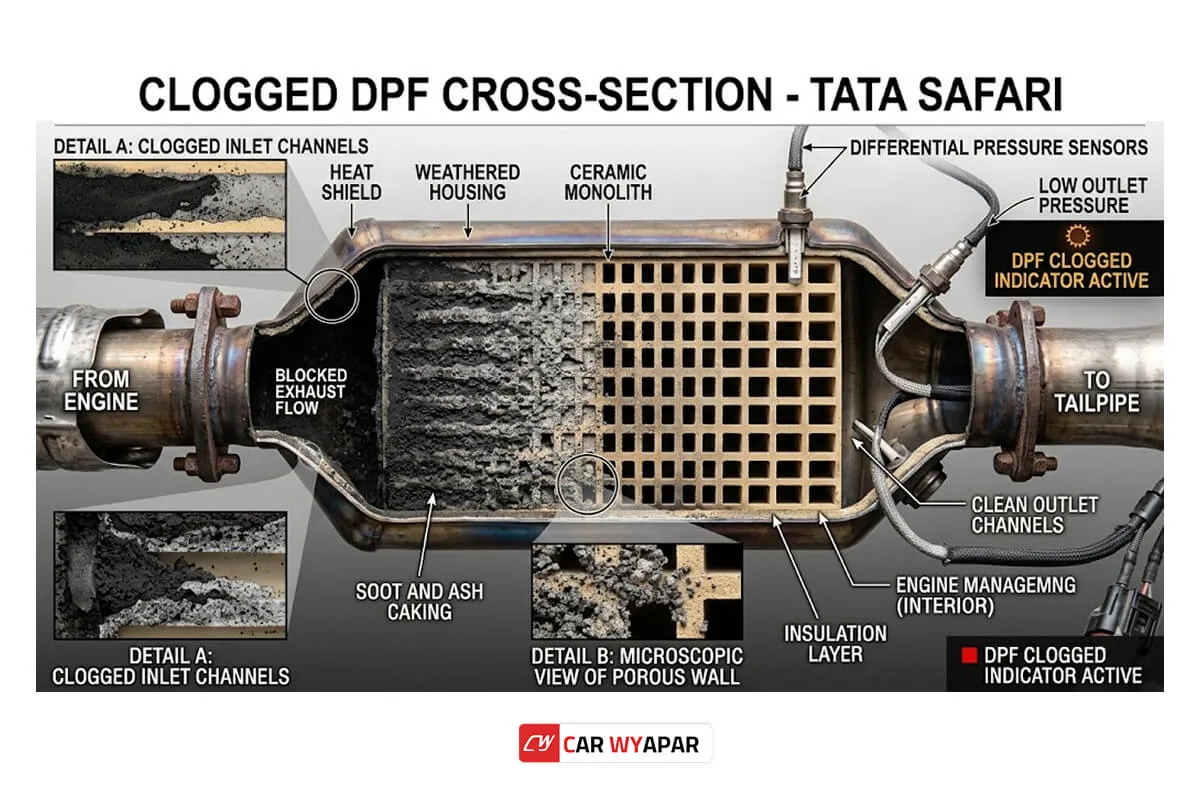
Diesel engines produce soot, very fine black particles. The DPF catches these particles and stores them. It acts like a filter inside your exhaust pipe. But storage is not forever. So the car has a process called regeneration. In simple words, it burns the collected soot at high temperature and turns it into ash.
Passive regeneration, during long and steady drives when exhaust temperature naturally reaches around 350°C to 500°C
Active regeneration, where the car increases temperature on its own to around 600°C by injecting extra fuel
If driving conditions are right, this process happens in the background. You won’t even notice it.
Why Tata Safari faces DPF clogging
The Tata Safari is a big diesel SUV. But many owners use it only in city traffic. Short drives, slow speed, constant braking. This is the worst case for a DPF system. DPF needs high temperature to clean itself. City driving does not generate enough heat. So soot keeps building up inside the filter.

Main reasons:
Frequent short trips
Heavy traffic driving
Not allowing regeneration to complete
Ignoring warning signs
In simple words, the car is built for open roads, but it lives in traffic jams.
Signs of DPF clogging
The car does give warnings, just not loudly.
Look for:
DPF warning light on dashboard
Loss of power
Reduced mileage
Engine going into limp mode
Ignore these, and the problem becomes expensive very fast.
What you should do
This is simple, but most people skip it.
Take the car for a highway drive regularly, 20 to 30 minutes
Maintain steady speed, around 60 to 80 kmph
Do not turn off the engine during regeneration
Use good quality diesel
If a warning comes, do not ignore it. A proper drive can often fix it.
DPF is good for the environment, but it demands the right driving style.
If your daily use is only city traffic, a diesel SUV like Tata Safari may not be ideal. Petrol or hybrid cars are easier to live with in such cases.
But if you do regular highway runs, then diesel still makes sense. Just drive it properly.
Otherwise, the car will not shout. It will quietly clog up, and then hit you with a repair bill that you won’t like.
Best RPM to clean DPF clogging in Tata Safari
Let’s keep it simple. Your car does not care about speed, it cares about heat. And heat comes from the right RPM.
For the Tata Safari diesel, the sweet spot is: 2000 to 2500 RPM.
This range helps the engine produce enough exhaust temperature to support DPF regeneration.
t low RPM, say 1200 to 1500:
Engine is relaxed
Exhaust temperature stays low
DPF cannot burn soot
At very high RPM, above 3000:
Engine is stressed
Not needed for regeneration
Just burns more fuel, no extra benefit
But at 2000 to 2500 RPM:
Exhaust temperature rises properly
Stays in the effective zone, roughly 350°C to 600°C
Perfect for passive or active regeneration
How to actually do it
Do not just stare at RPM meter and pray. Drive it right.
Take the car on a highway or open road
Use 3rd or 4th gear
Maintain 2000 to 2500 RPM steadily
Drive for 15 to 30 minutes without stopping
This gives enough time and temperature for the DPF to clean itself.
One mistake people make
A lot of people press the accelerator hard while the car is not moving. Engine goes “vroom vroom”, and they think soot is getting burned.
When you press the accelerator in neutral:
Engine RPM increases
But engine load stays very low
Fuel injection is limited by ECU to avoid waste
Turbocharger does not build strong boost
Exhaust gas flow is weak
Most important, exhaust temperature does not rise enough
So yes, RPM goes up, but heat does not follow properly.
And DPF needs heat, not stupidity.
For DPF regeneration:
Passive cleaning needs roughly 350°C to 500°C
Active regeneration targets around 550°C to 650°C
When you rev in neutral:
Exhaust temp may briefly rise to around 200°C to 300°C
It drops quickly because there is no load to sustain combustion heat
Also, modern cars like Tata Safari are smart:
ECU will not trigger active regeneration when the car is stationary
It avoids overheating parts and wasting fuel
So even if you rev to 3000 RPM standing still, the system refuses to do the actual cleaning process.
Why driving works but revving does not
When you drive at 2000 to 2500 RPM in gear:
Engine is under real load
More fuel is burned
Turbo builds boost
Exhaust flow is strong
Temperature rises and stays high
This steady heat is what burns soot inside the DPF.
Tata Safari DPF Damage Cost
|
Stage |
What’s Happening |
Symptoms |
What Needs to Be Done |
Estimated Cost (₹) |
|---|---|---|---|---|
|
Level 1 |
Light soot buildup |
DPF light comes on, slight mileage drop |
Highway drive to allow regeneration |
0 to 500 |
|
Level 2 |
Partial clogging |
Power loss, frequent warning light |
Forced regeneration at service center |
1,500 to 3,500 |
|
Level 3 |
Heavy clogging |
Limp mode, strong power loss |
Manual cleaning of DPF (chemical or machine) |
5,000 to 12,000 |
|
Level 4 |
Severe blockage |
Car struggles to run, high back pressure |
DPF removal and deep cleaning or partial repair |
15,000 to 30,000 |
|
Level 5 |
DPF failure |
Constant errors, no regeneration possible |
Full DPF replacement |
50,000 to 1,20,000 |
|
Level 6 |
Secondary damage |
Turbo stress, EGR issues, engine strain |
Turbo/EGR repair along with DPF fix |
30,000 to 1,50,000+ |
Why Your Car Feels Sluggish
|
Symptom |
Possible Cause |
What’s Happening Technically |
Focus on DPF Case |
|---|---|---|---|
|
Slow acceleration |
DPF clogging |
Exhaust gases cannot flow freely, back pressure builds up |
Engine struggles to push gases out, power drops |
|
Engine feels heavy |
DPF clogging |
High back pressure reduces engine efficiency |
Feels like car is carrying extra weight |
|
Sudden power loss |
Limp mode (DPF or sensor issue) |
ECU limits power to protect engine |
Very common in heavily clogged DPF |
|
Poor mileage |
DPF clogging or injector issue |
Engine burns more fuel to compensate |
Active regeneration also increases fuel use |
|
Delayed throttle response |
Turbo lag or DPF blockage |
Turbo cannot spool properly due to restricted exhaust |
DPF blocks exhaust flow, turbo performance drops |
|
Frequent gear downshift |
Low power output |
Engine cannot maintain speed |
Seen when DPF is partially blocked |
|
Engine overheating feel |
Exhaust heat not exiting properly |
Heat builds up in system |
DPF traps heat along with soot |
|
Warning lights on dashboard |
DPF, EGR, or sensor issue |
System detects abnormal exhaust conditions |
DPF warning is direct sign |
|
Black smoke (rare in BS6) |
Injector or EGR fault |
Incomplete combustion |
If DPF is damaged or removed |
|
Jerky driving |
Fuel-air imbalance or clogging |
Combustion not smooth |
Happens when DPF is heavily clogged |
|
DPF Condition |
What Driver Feels |
What’s Happening Inside |
|---|---|---|
|
Light clogging |
Slight lag, small mileage drop |
Soot buildup starts restricting flow |
|
Medium clogging |
Noticeable power loss, frequent warnings |
Back pressure rises, turbo efficiency drops |
|
Heavy clogging |
Car goes into limp mode |
ECU limits power to prevent damage |
|
Severe clogging |
Car barely moves properly |
Exhaust almost blocked, engine choking |
|
DPF failure |
Constant sluggishness + errors |
No regeneration possible, system breakdown |